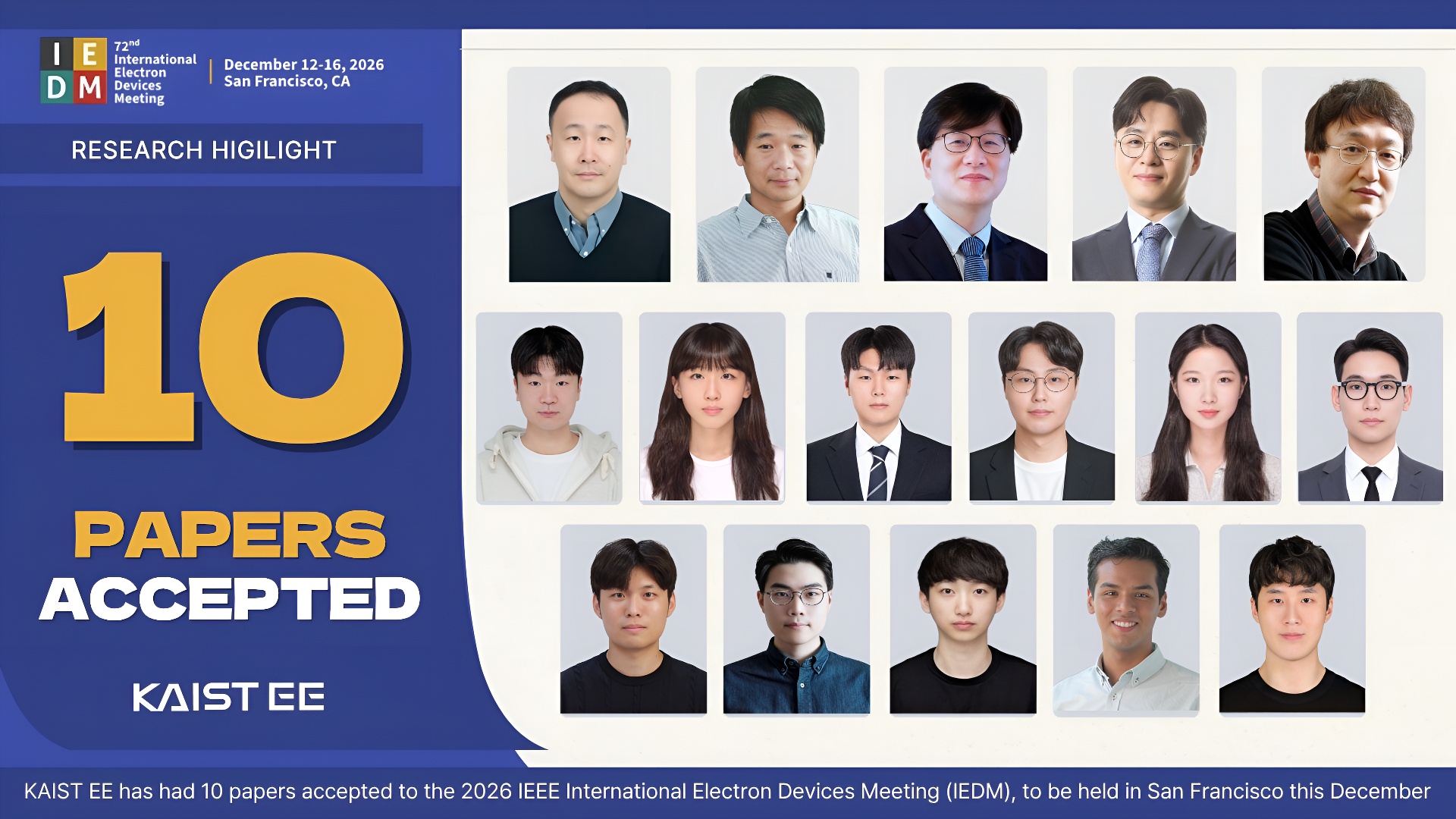
KAIST EE has had 10 papers accepted to the 2026 IEEE International Electron Devices Meeting (IEDM), to be held in San Francisco this December.
Widely regarded as one of the world’s most prestigious conferences in the field of semiconductor devices, IEDM is where key technologies from the global semiconductor industry and academic community are unveiled for the first time. It is often called the “Super Bowl of Semiconductors” or the “Semiconductor Olympics.”
Papers from five research groups led by Professors Sanghyeon Kim, Mincheol Shin, Seunghyup Yoo, Sanghun Jeon, and Byung Jin Cho were accepted. Spanning next-generation memory and AI computing, RF and power devices, intelligent sensors, and quantum devices, the papers demonstrate the School’s broad-based competitiveness in semiconductor research.
Professor Sanghyeon Kim’s group, which had five papers accepted, pushed beyond both performance and integration limits in next-generation system semiconductors through research spanning photonic semiconductors, RF interposers, 3D-integrated power delivery networks, thermal reliability, and quantum devices.
– First Demonstration of an Ultrafast Wavelength-Tunable Laser for LiDAR Incorporating a III-V/Insulator/Si Hybrid Structure (First author: Shin Hyung Lee, Ph.D. student)
To address the heat generation and optical loss of conventional lasers, the team demonstrated for the first time a Vernier ring laser incorporating an InGaAsP-based SISCAP structure on a 220 nm SOI platform. The laser achieved a response time of 5.7 ns and a wavelength tuning range of 28.56 nm, improving the speed and efficiency of next-generation FMCW LiDAR.
– Active SiC RF Interposer Platform with Embedded InGaAs HEMTs (First author: Nahyun Rheem, Ph.D. student)
To simultaneously address transmission loss and heat generation in millimeter-wave communications, the team integrated InGaAs HEMT active cells on a SiC interposer. The CPW transmission lines fabricated on the SiC interposer achieved low-loss transmission of approximately 0.5 dB/mm at 50 GHz. Furthermore, the 3D-integrated InGaAs HEMTs set a world record for high-frequency performance among devices integrated on other substrates, while reducing thermal resistance by 11.8%, thereby enhancing both the integration density and thermal management of RF systems.
– Heterogeneous 3D (H3D)-Integrated Power Delivery System with Optimized Heat Dissipation (Co-first authors: Minhyuk Lee, master’s student; Chan Jik Lee, Ph.D. student)
The team demonstrated for the first time a heterogeneous 3D power delivery system that vertically integrates CMOS, GaN power switches, and 3D pillar capacitors. Under the worst-case operating condition where both CMOS and GaN power switches operate simultaneously, a dedicated heat-spreading layer lowered the capacitor temperature from 160°C to 127°C and reduced thermal resistance by more than half to 3.60 K·mm/W. Through capacitor material and structural engineering, the system secured a reliable operating lifetime of 19.6 years even in high-temperature environments.
– Precision Thermal Mapping of GaN HEMTs Using Two-Dimensional Thermoreflectance Microscopy (TRM) (Co-first authors: Chaeyeon Han, master’s student; Chan Jik Lee, Ph.D. student) *Outcome from Undergraduate Research Program (URP)
Thermal-aware device design is critical for high-frequency GaN HEMTs commonly used in base stations. The team systematically investigated 2D heat generation profiles in 200-mm GaN-on-Si RF devices fabricated by imec using two-dimensional thermoreflectance microscopy. For the first time, thermal behavior variations based on thin-film structures, field-plate configurations, and bias conditions were experimentally observed, establishing a direct correlation between thermal dynamics and physical breakdown locations. By quantifying localized thermal stress, this work provides a foundation for enhancing the design accuracy and reliability of high-voltage, high-frequency devices.
– Ultra-Low-Noise InGaAs HEMT for Quantum-Computing Readout at 4 K (First author: Jaeyong Jeong, Ph.D. [former postdoctoral researcher, currently Assistant Professor at UNIST])
By optimizing the quantum-well heterostructure and fabrication process, the team substantially reduced the 1/f low-frequency noise of quantum-computing readout circuits. The device achieved world-leading low-noise performance at 4 K, providing a foundation for accurately reading faint quantum signals.
Professor Mincheol Shin’s group presented a design technology that links actual fabrication processes with quantum transport analysis to more accurately predict the behavior of ultrascaled nanosheet transistors.
– Process-Device-Coupled Quantum Transport Simulation of p-Type SiGe Nanosheet Transistors (First author: Gyeongwon Roh, master’s student)
The team developed a transport simulation that accounts for position-dependent strain and DFT-based Si/Ge alloy-disorder scattering. The good agreement between the calculated and experimental results will help reduce the cost and time required to develop nanodevices, a process that has relied on repeated fabrication and measurement.
Professor Seunghyup Yoo’s group integrated organic and thin-film photonic devices with CMOS technology on a single chip, creating an intelligent sensor platform that not only detects light but also processes image data directly.
– Reconfigurable Thin-Film Image Sensor with a 3T + 2PD Architecture (First author: Sangin Han, Ph.D.)
By vertically integrating a thin-film quantum-dot photodetector in a back-to-back configuration on top of an imec’s CMOS image sensor, the team succeeded in controlling the magnitude and polarity of the output using voltage. The sensor performs in-sensor computing like edge extraction and blurring directly and can selectively operate in the visible and short-wave infrared bands, simplifying robotic vision and industrial inspection systems.
Professor Sanghun Jeon’s group had two papers accepted on neuromorphic vision and in-memory computing technologies. Both studies reduce the power consumption and latency associated with data movement at the device level.
– W2W-Integrated Neuromorphic Intelligent Image Sensor (First author: Seungyeop Kim, Ph.D. student)
The team vertically integrated a photodetector with a spike-conversion circuit and implemented positive and negative weighted operations within each pixel. By performing image feature extraction and spike encoding without an ADC, the sensor brings ultra-low-power neuromorphic vision closer to practical deployment.
– Selector-Free 3-Bit FTJ Crossbar Based on a Multifunctional MoO₂ Electrode (First author: Paul Gallegos Sanchez, integrated master’s-Ph.D. student)
The MoO₂ bottom electrode was designed to simultaneously control the work function and regulate oxygen vacancies, enhancing the rectification and ferroelectric properties of the FTJ. Without a separate selector, the device achieved a tunneling electroresistance ratio above 30,000 and a rectification ratio above 5,000, suppressing leakage current in the crossbar and demonstrating multibit AI computing performance.
Professor Byung Jin Cho’s group identified the physical mechanism that degrades the reliability of next-generation 3D memory and proposed a new operating algorithm that precisely controls the device’s internal state.
– Pass-Disturb Suppression in FeFET-Based 3D NAND Flash Memory (First author: Seunghun Kim, integrated master’s-Ph.D. student)
The team developed a pre-switching algorithm based on the multidomain characteristics of HfO₂-based ferroelectrics, exploiting the principle that different internal domain configurations can exist even under the same apparent electrical state. By suppressing pass disturb, a key challenge in next-generation ferroelectric-FET-based 3D NAND flash memory, the approach offers a new route toward reliable operation without altering the device structure or materials.
“The acceptance of 10 papers from five research groups at IEDM demonstrates that the KAIST School of Electrical Engineering has world-class research capabilities across a wide range of next-generation semiconductor fields,” said Professor Seunghyup Yoo, Head of the School of Electrical Engineering. “We will continue to lead research in fields that will drive national strategic technologies and future industries, including AI semiconductors, high-speed communications, intelligent sensors, and quantum devices.”