Geon Lee, Minyoung Choe and Kijung Shin
IJCAI 2022: International Joint Conference on Artificial Intelligence 2022
Abstract: Sequences of group interactions, such as emails, online discussions, and co-authorships, are ubiquitous; and they are naturally represented as a stream of hyperedges. Despite their broad potential applications, anomaly detection in hypergraphs (i.e., sets of hyperedges) has received surprisingly little attention, compared to that in graphs. While it is tempting to reduce hypergraphs to graphs and apply existing graph-based methods, according to our experiments, taking higher-order structures of hypergraphs into consideration is worthwhile. We propose HashNWalk, an incremental algorithm that detects anomalies in a stream of hyperedges. It maintains and updates a constant-size summary of the structural and temporal information about the stream. Using the summary, which is the form of a proximity matrix, HashNWalk measures the anomalousness of each new hyperedge as it appears. HashNWalk is (a) Fast: it processes each hyperedge in near real-time and billions of hyperedges within a few hours, (b) Space Efficient: the size of the maintained summary is a predefined constant, (c) Effective: it successfully detects anomalous hyperedges in real-world hypergraphs.

Hyunjin Hwang*, Seungwoo Lee*, Chanyoung Park, and Kijung Shin
SIGIR 2022: International ACM SIGIR Conference on Research and Development in Information Retrieval 2022
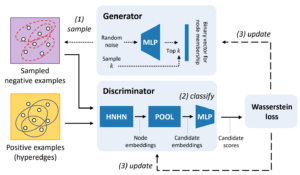
Abstract: Hypergraphs (i.e., sets of hyperedges) naturally represent group relations (e.g., researchers co-authoring a paper and ingredients used together in a recipe), each of which corresponds to a hyperedge (i.e., a subset of nodes). Predicting future or missing hyperedges bears significant implications for many applications (e.g., collaboration and recipe recommendation). What makes hyperedge prediction particularly challenging is the vast number of non-hyperedge subsets, which grows exponentially with the number of nodes. Since it is prohibitive to use all of them as negative examples for model training, it is inevitable to sample a very small portion of them, and to this end, heuristic sampling schemes have been employed. However, trained models suffer from poor generalization capability for examples of different natures. In this paper, we propose AHP, an adversarial training-based hyperedge-prediction method. It learns to sample negative examples without relying on any heuristic schemes. Using six real hypergraphs, we show that AHP generalizes better to negative examples of various natures. It yields up to 28.2% higher AUROC than the best existing methods and often even outperforms its variants with sampling schemes tailored to test sets.
Shinhwan Kang, Kyuhan Lee, and Kijung Shin
PAKDD 2022: Pacific-Asia Conference on Knowledge Discovery and Data Mining 2022
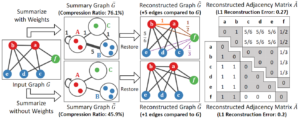
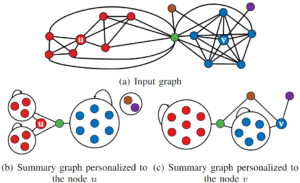
Abstract: Which one is better between two representative graph summarization models with and without edge weights? From web graphs to online social networks, large graphs are everywhere. Graph summarization, which is an effective graph compression technique, aims to find a compact summary graph that accurately represents a given large graph. Two versions of the problem, where one allows edge weights in summary graphs and the other does not, have been studied in parallel without direct comparison between their underlying representation models. In this work, we conduct a systematic comparison by extending three search algorithms to both models and evaluating their outputs on eight datasets in five aspects: (a) reconstruction error, (b) error in node importance, (c) error in node proximity, (d) the size of reconstructed graphs, and (e) compression ratios. Surprisingly, using unweighted summary graphs leads to outputs significantly better in all the aspects than using weighted ones, and this finding is supported theoretically. Notably, we show that a state-of-the-art algorithm can be improved substantially (specifically, 8.2X, 7.8X, and 5.9X in terms of (a), (b), and (c), respectively, when (e) is fixed) based on the observation.
Shinhwan Kang, Kyuhan Lee, and Kijung Shin
ICDE 2022: IEEE International Conference on Data Engineering 2022
Abstract: Are users of an online social network interested equally in all connections in the network? If not, how can we obtain a summary of the network personalized to specific users? Can we use the summary for approximate query answering? As massive graphs (e.g., online social networks, hyperlink networks, and road networks) have become pervasive, graph compression has gained importance for the efficient processing of such graphs with limited resources. Graph summarization is an extensively-studied lossy compression method. It provides a summary graph where nodes with similar connectivity are merged into supernodes, and a variety of graph queries can be answered approximately from the summary graph. In this work, we introduce a new problem, namely personalized graph summarization, where the objective is to obtain a summary graph where more emphasis is put on connections closer to a given set of target nodes. Then, we propose PeGaSus, a linear-time algorithm for the problem. Through experiments on six real-world graphs, we demonstrate that PeGaSus is (a) Effective: node-similarity queries for target nodes can be answered significantly more accurately from personalized summary graphs than from non-personalized ones of similar size, (b) Scalable: it summarizes graphs with up to one billion edges, and (c) Applicable to distributed multi-query answering: it successfully replaces graph partitioning for communication-free multi-query processing.
Kyuhan Lee*, Jihoon Ko*, and Kijung Shin
ICDE 2022: IEEE International Conference on Data Engineering 2022
Abstract: Given a massive graph, how can we exploit its hierarchical structure for concisely but exactly summarizing the graph? By exploiting the structure, can we achieve better compression rates than state-of-the-art graph summarization methods?
The explosive proliferation of the Web has accelerated the emergence of large graphs, such as online social networks and hyperlink networks. Consequently, graph compression has become increasingly important to process such large graphs without expensive I/O over the network or to disk. Among a number of approaches, graph summarization, which in essence combines similar nodes into a supernode and describe their connectivity concisely, protrudes with several advantages. However, we note that it fails to exploit pervasive hierarchical structures of real-world graphs as its underlying representation model enforces supernodes to be disjoint.
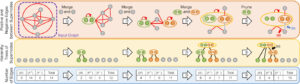
In this work, we propose the hierarchical graph summarization model, which is an expressive graph representation model that includes the previous one proposed by Navlakha et al. as a special case. The new model represents an unweighted graph using positive and negative edges between hierarchical supernodes, each of which can contain others. Then, we propose Slugger, a scalable heuristic for concisely and exactly representing a given graph under our new model. Slugger greedily merges nodes into supernodes while maintaining and exploiting their hierarchy, which is later pruned. Slugger significantly accelerates this process by sampling, approximation, and memoization. Our experiments on 16 real-world graphs show that Slugger is (a) Effective: yielding up to 29.6% more concise summary than state-of-the-art lossless summarization methods, (b) Fast: summarizing a graph with 0.8 billion edges in a few hours, and (c) Scalable: scaling linearly with the number of edges in the input graph.
Minyoung Choe, Jaemin Yoo, Geon Lee, Woonsung Baek, U Kang, and Kijung Shin
WWW 2022: The Web Conference 2022
Abstract: Graphs are widely used for representing pairwise interactions in complex systems. Since such real-world graphs are large and often evergrowing, sampling a small representative subgraph is indispensable for various purposes: simulation, visualization, stream processing, representation learning, crawling, to name a few. However, many complex systems consist of group interactions (e.g., collaborations of researchers and discussions on online Q&A platforms), and thus they can be represented more naturally and accurately by hypergraphs (i.e., sets of sets) than by ordinary graphs.
Motivated by the prevalence of large-scale hypergraphs, we study the problem of representative sampling from real-world hypergraphs, aiming to answer (Q1) what a representative sub-hypergraph is and (Q2) how we can find a representative one rapidly without an extensive search. Regarding Q1, we propose to measure the goodness of a sub-hypergraph by comparing it with the entire hypergraph in terms of ten graph-level, hyperedge-level, and node-level statistics. Regarding Q2, we first analyze the characteristics of six intuitive approaches in 11 real-world hypergraphs. Then, based on the analysis, we propose MiDaS, which draws hyperedges with a bias towards those with high-degree nodes. Through extensive experiments, we demonstrate that MiDaS is (a) Representative: finding overall the most representative samples among 13 considered approaches, (b) Fast: several orders of magnitude faster than the strongest competitors, which performs an extensive search, and (c) Automatic: rapidly searching a proper degree of bias.

Hyunjin Choo and Kijung Shin
SDM 2022: SIAM International Conference on Data Mining 2022
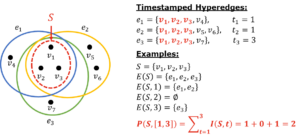
Abstract: A hypergraph, which generalizes an ordinary graph, naturally represents group interactions as hyperedges (i.e., arbitrary-sized subsets of nodes). Such group interactions are ubiquitous: the sender and receivers of an email, the co-authors of a publication, and the items co-purchased by a customer, to name a few. A higher-order interaction (HOI) in a hypergraph is defined as the co-appearance of a set of nodes in any hyperedge. Our focus is the persistence of HOIs repeated over time, which is naturally interpreted as the strength of group relationships, aiming at answering three questions: (a) How do HOIs in real-world hypergraphs persist over time? (b) What are the key factors governing the persistence? (c) How accurately can we predict the persistence? In order to answer these questions, we investigate the persistence of HOIs in 13 real-world hypergraphs. First, we define how to measure the persistence of HOIs. Then, we examine global patterns and anomalies in the persistence, revealing a power-law relationship. After that, we study the relations between the persistence and 16 structural features of HOIs, some of which are closely related to the persistence. Lastly, based on the 16 structural features, we assess the predictability of the persistence under various settings and find strong predictors. Note that predicting the persistence of HOIs has many potential applications, such as recommending items to be purchased together and predicting missing recipients of emails.
Hyeonjeong Shin, Taehyung Kwon, Neil Shah, and Kijung Shin
WSDM 2022: International Conference on Web Search and Data Mining 2022
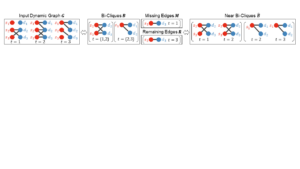
Abstract: A variety of tasks on dynamic graphs, including anomaly detection, community detection, compression, and graph understanding, have been formulated as problems of identifying constituent (near) bi-cliques (i.e., complete bipartite graphs). Even when we restrict our attention to maximal ones, there can be exponentially many near bi-cliques, and thus finding all of them is practically impossible for large graphs. Then, two questions naturally arise: (Q1) What is a “good” set of near bi-cliques? That is, given a set of near bi-cliques in the input dynamic graph, how should we evaluate its quality? (Q2) Given a large dynamic graph, how can we rapidly identify a high-quality set of near bi-cliques in it? Regarding Q1, we measure how concisely, precisely, and exhaustively a given set of near bi-cliques describes the input dynamic graph. We combine these three perspectives systematically on the Minimum Description Length principle. Regarding Q2, we propose CutNPeel, a fast search algorithm for a high-quality set of near bi-cliques. By adaptively re-partitioning the input graph, CutNPeel reduces the search space and at the same time improves the search quality. Our experiments using six real-world dynamic graphs demonstrate that CutNPeel is (a) High-quality: providing near bi-cliques of up to 51.2% better quality than its state-of-the-art competitors, (b) Fast: up to 68.8x faster than the next-best competitor, and (c) Scalable: scaling to graphs with 134 million edges. We also show successful applications of CutNPeel to graph compression and pattern discovery.
Geon Lee and Kijung Shin
ICDM 2021: IEEE International Conference on Data Mining 2021
Abstract: Group interactions arise in our daily lives (email communications, on-demand ride sharing, comment interactions on online communities, to name a few), and they together form hypergraphs that evolve over time. Given such temporal hypergraphs, how can we describe their underlying design principles? If their sizes and time spans are considerably different, how can we compare their structural and temporal characteristics?
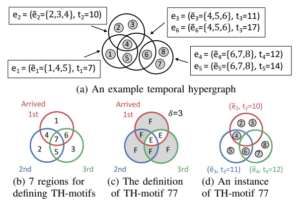
In this work, we define 96 temporal hypergraph motifs (TH-motifs), and propose the relative occurrences of their instances as an answer to the above questions. TH-motifs categorize the relational and temporal dynamics among three connected hyperedges that appear within a short time. For scalable analysis, we develop THyMe+, a fast and exact algorithm for counting the instances of TH-motifs in massive hypergraphs, and show that THyMe+ is at most 2,163X faster while requiring less space than baseline. Using it, we investigate 11 real-world temporal hypergraphs from various domains. We demonstrate that TH-motifs provide important information useful for downstream tasks and reveal interesting patterns, including the striking similarity between temporal hypergraphs from the same domain.
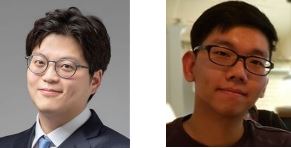
[왼쪽부터 김성민교수, 배강민 박사과정(1저자)]
최근 모바일 시스템 분야의 최고 권위 국제 학술대회인 `ACM 모비시스(ACM MobiSys)’ 2022에 발표한 논문이 최우수논문상을 수상했습니다.
작년 KAIST 전기및전자공학부에서 아시아 대학 최초로 MobiSys 최우수논문상을 받은 이후 연속된 수상입니다.
연구성과 : 전기및전자공학부 김성민 교수 연구팀, 천 개 ~ 수천만 개 이상의 대규모 사물인터넷(IoT) 동시 통신 기술 최초 개발
– 밀리미터파 후방산란 시스템 기술로 초저전력 대규모 통신 설계 성공
– 기존에는 다양한 장애물과 반사체가 설치된 환경에서 제대로 작동하지 않았던 문제점을 해결
– 2035년까지 1조 개 이상의 사물인터넷 기기가 생산될 전망에서 높은 실용성 및 확장성으로 초연결 시대를 위한 핵심 역할 기대
전기및전자공학부 김성민 교수 연구팀이 세계 최초로 천 개에서 수천만 개에 이르는 대규모 사물인터넷(IoT) 동시 통신을 위한 `밀리미터파 후방산란 시스템’을 개발했다고 28일 밝혔다.
KAIST 전기및전자공학부 배강민 박사과정이 제1 저자로 참여한 이번 연구는 모바일 시스템 분야의 최고 권위 국제 학술대회인 `ACM 모비시스(ACM MobiSys)’ 2022에 이번 6월 발표됐으며, 최우수논문상을 수상했다.
(논문명: OmniScatter: extreme sensitivity mmWave backscattering using commodity FMCW radar).
이는 작년 KAIST 전기및전자공학부에서 아시아 대학 최초로 ACM 모비시스 2021 최우수논문상을 받은 이후 연속된 수상으로 더욱 의미가 깊다.
연구팀의 후방산란 기술은 10마이크로와트(μW) 이하의 초저전력으로 작동해 코인 전지 하나로 40년 이상 구동 가능해 설치 및 유지보수 비용을 크게 줄일 수 있다.
이번 성과는 5G/6G 등 차세대 통신에서 요구하는 네트워크 밀도를 훨씬 웃도는 연결성을 자랑한다. 이에, 이번 시스템은 향후 도래할 초연결 시대를 위한 디딤돌 역할을 할 수 있을 것으로 기대된다.
김성민 교수는 “밀리미터파 후방산란은 대규모로 사물인터넷 기기들을 구동할 수 있는 꿈의 기술이며 이는 기존 어떠한 기술보다도 더욱 대규모의 통신을 초저전력으로 구동할 수 있다ˮ라며 ” 이 기술이 앞으로 도래할 초연결 시대에 사물인터넷의 보급을 위해 적극적으로 활용되길 기대한다ˮ라고 말했다.
이번 연구는 삼성미래기술육성사업과 정보통신기획평가원의 지원을 받아 수행됐다.
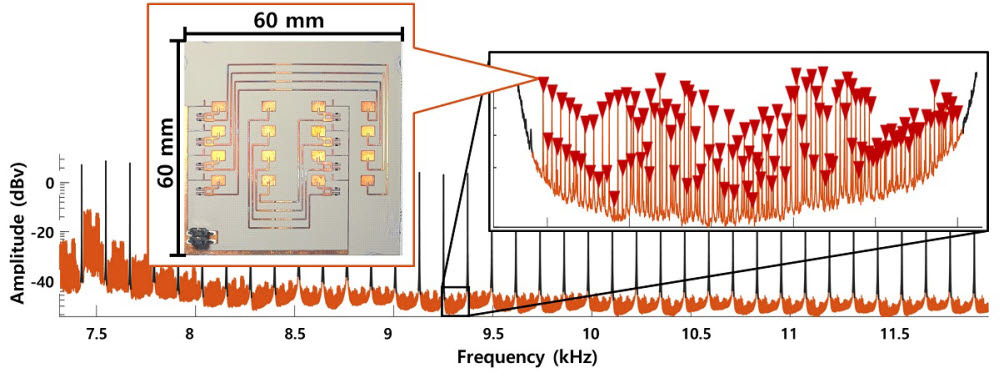
[연구성과도 1. 대규모 IoT 통신을 위한 태그(붉은색 삼각형). 1100개 태그 신호가 충돌없이 동시 통신]
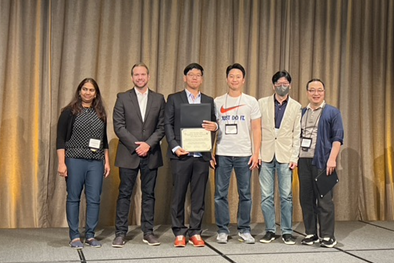
[수상 행사 사진]
관련 언론 기사링크 : 전자신문 등