
A Reconfigurable Silicon Transistor for Noise-Resilient Stochastic Spiking Neural Networks(최양규 교수 연구실)

Abstract

Spiking neural networks (SNNs) are energy-efficient neuromorphic architectures that emulate the event-driven signaling of biological neurons. However, their reliance on deterministic neuron models limits their ability to capture the intrinsic stochasticity of real neural systems, limiting their noise resilience and adaptability. To overcome these limitations, stochastic SNNs (SSNNs) have emerged, incorporating probabilistic behavior to enhance noise tolerance and enable probabilistic exploration. In this study, we implemented a neuronal transistor (neuristor) by reengineering conventional CMOS technology based on well-established silicon and its derivatives, enabling dual functionality by exhibiting both stochastic and deterministic properties for reliable and noise-resilient SSNNs. The neuristor integrates stochastic encoding in the input layer and leaky integrate-and-fire (LIF) behavior in the hidden and output layers within a single device. The neuristor utilizes the single transistor latch (STL) mechanism, where impact ionization induces stochastic spiking under specific conditions, while controlled charge accumulation triggers LIF firing under others. This reconfigurable dual-mode operation enables the same neuristor to function across all network layers, simplifying circuit design and enhancing scalability. A neuristor-based SSNN achieved 92% classification accuracy on the MNIST data set under 30% Gaussian noise, demonstrating strong noise resilience and validating its applicability for biologically inspired, energy-efficient neuromorphic systems.


Main Figure

images large nn5c15076 0006

Preventing Vanishing Gradient Problem of Hardware Neuromorphic System by Implementing Imidazole-Based Memristive ReLU Activation Neuron (최성율 교수 연구실)

Abstract

With advances in artificial intelligent services, brain-inspired neuromorphic systems with synaptic devices are recently attracting significant interest to circumvent the von Neumann bottleneck. However, the increasing trend of deep neural network parameters causes huge power consumption and large area overhead of a nonlinear neuron electronic circuit, and it incurs a vanishing gradient problem. Here, a memristor-based compact and energy-efficient neuron device is presented to implement a rectifying linear unit (ReLU) activation function. To emulate the volatile and gradual switching of the ReLU function, a copolymer memristor with a hybrid structure is proposed using a copolymer/inorganic bilayer. The functional copolymer film developed by introducing imidazole functional groups enables the formation of nanocluster-type pseudo-conductive filaments by boosting the nucleation of Cu nanoclusters, causing gradual switching. The ReLU neuron device is successfully demonstrated by integrating the memristor with amorphous InGaZnO thin-film transistors, and achieves 0.5 pJ of energy consumption based on sub-10 µA operation current and high-speed switching of 650 ns. Furthermore, device-to-system-level simulation using neuron devices on the MNIST dataset demonstrates that the vanishing gradient problem is effectively resolved by five-layer deep neural networks. The proposed neuron device will enable the implementation of high-density and energy-efficient hardware neuromorphic systems.


Main Figure

2

Experimental demonstration of third-order memristor-based artificial sensory nervous system for neuro-inspired robotics (최신현 교수 연구실)

Abstract

The sensory nervous system in animals enables the perception of external stimuli. Developing an artificial sensory nervous system has been widely conducted to realize neuro-inspired robots capable of effectively responding to external stimuli. However, it remains challenging to develop artificial sensory nervous systems that possess sophisticated biological functions, such as habituation and sensitization, enabling efficient responses without bulky peripheral circuitry. Here, we introduce a memristor device with third-order switching complexity, emulating an artificial synapse that inherently possesses habituation and sensitization properties. Incorporating an additional resistive switching TiOx layer into the HfO2 memristor exhibits third-order switching complexity and non-volatile habituation characteristics. Based on the third-order memristor, we propose a robotic system equipped with a memristor-based artificial sensory nervous system for optimizing the robot arm’s response to external stimuli without the aid of processors. It is experimentally demonstrated that the robot arm with the developed memristor-based artificial sensory nervous system ignores approximately 71% of safe and familiar stimuli while sensitively responding to threatening and significant stimuli, similar to the habituation and sensitization of biological sensory nervous systems. Our findings can be a stepping stone for energy-efficient and intelligent robotic systems with reduced hardware burden.

Main Figure

Realistic Chest X-Ray Image Synthesis via Generative Network with Stochastic Memristor Array for Machine Learning-Based Medical Diagnosis (최성율 교수 연구실))

Abstract

Artificial Intelligence (AI) technology has attracted tremendous interest in the medical community, from image analysis to lesion diagnosis. However, progress in medical AI is hampered by a lack of available medical image datasets and labor-intensive labeling processes. Here, it is demonstrated that a large number of annotated, realistic chest X-ray images can be generated using a state-of-the-art generative adversarial network (GAN) that exploits noise produced by stochastic in-memory computing of memristor crossbar arrays. Memristors based on polymer film with high thermal resistance can increase the stochasticity of the tunneling distance for randomly ruptured conductive filaments via excessive Joule heating, thus generating true random numbers required for creating naturally diverse images in GAN. Using StyleGAN2-adaptive discriminator augmentation (ADA), high-quality chest X-ray images with and without pneumothorax are successfully augmented while maintaining a good Frechet inception distance score. The results provide a cost-effective solution for preparing privacy-sensitive medical images and labeling to develop innovative medical AI algorithms.

Main Figure

교수님

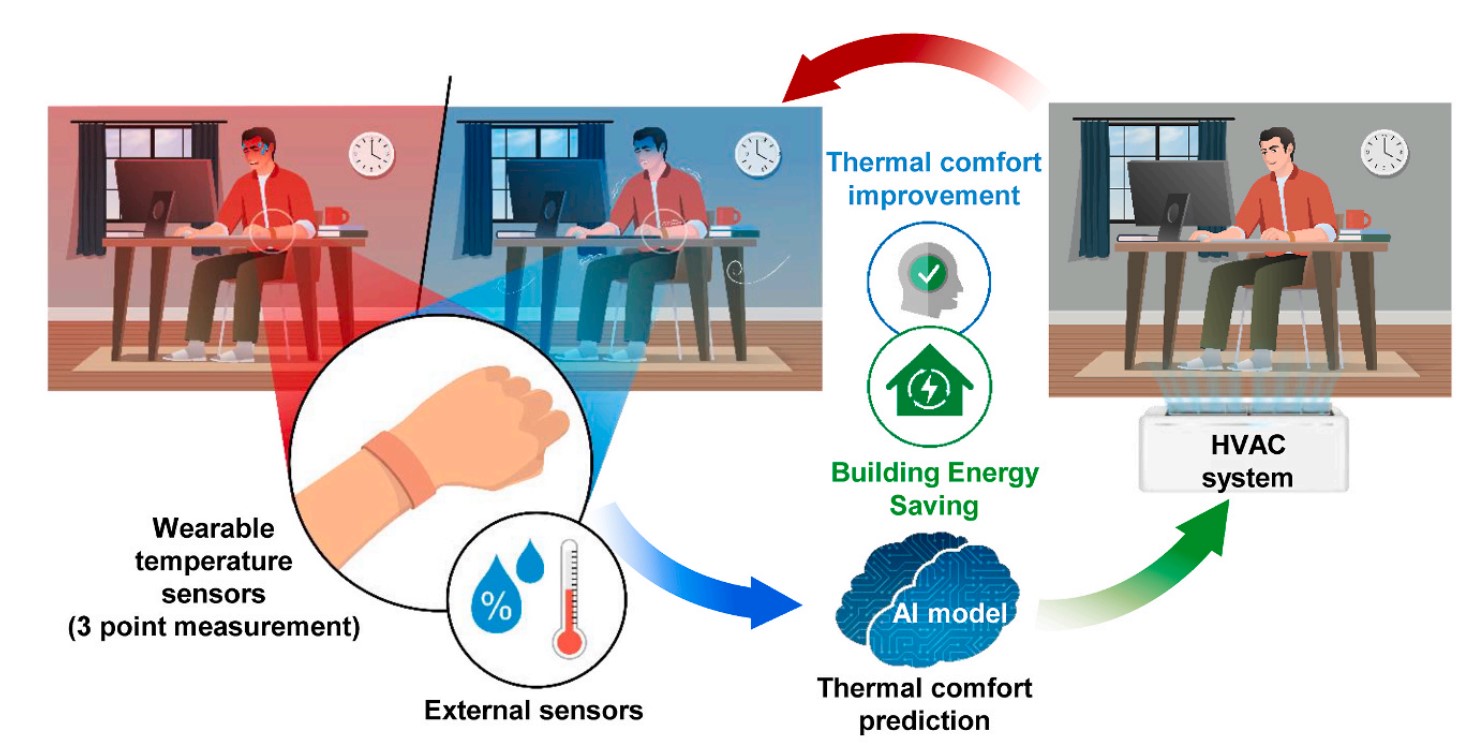
Wireless, AI-enabled wearable thermal comfort sensor for energy-efficient, human-in-the-loop control of indoor temperature (정재웅 교수 연구실)

Title: Wireless, AI-enabled wearable thermal comfort sensor for energy-efficient, human-in-the-loop control of indoor temperature

Abstract: The conventional heating, ventilation, and air conditioning (HVAC) systems are based on a set-point control approach that only considers the temperature of the environment without reflecting the thermophysiological status of the occupant. This approach not only fails to fully satisfy individual thermal preferences, but it also makes an HVAC operation energy-inefficient. One possible solution is to control the indoor thermal condition based on an accurate prediction of the occupant’s thermal comfort to prevent any unnecessary energy consumption. Here, we present an artificial intelligence (AI) wearable sensor-based human-in-the-loop HVAC control system that is operated on a real-time basis reflecting the thermophysiological condition of the occupant to automatically improve their thermal comfort while reducing the energy consumption of the building. The wristband-type, AI-based, three-point wearable temperature sensor offers excellent thermal comfort prediction accuracy (93.9%), enabling a human-centric HVAC control operation. A proof-of-concept demonstration of closed human-in-the-loop HVAC control using the AI-enabled wearable sensor system confirms both the accuracy of the thermal comfort prediction and the energy-efficiency of this approach, demonstrating its potential as a new solution that improves the occupant’s thermal comfort and provides building energy savings.

1

3D Neuromorphic Hardware with Single Thin-Film Transistor Synapses Over Single Thin-Body Transistor Neurons by Monolithic Vertical Integration (최양규 교수 연구실)

Title: 3D Neuromorphic Hardware with Single Thin-Film Transistor Synapses Over Single Thin-Body Transistor Neurons by Monolithic Vertical Integration

Abstract: Neuromorphic hardware with a spiking neural network (SNN) can significantly enhance the energy efficiency for artificial intelligence (AI) functions owing to its event-driven and spatiotemporally sparse operations. However, an artificial neuron and synapse based on complex complementary metal-oxide-semiconductor (CMOS) circuits limit the scalability and energy efficiency of neuromorphic hardware. In this work, a neuromorphic module is demonstrated composed of synapses over neurons realized by monolithic vertical integration. The synapse at top is a single thin-film transistor (1TFT-synapse) made of poly-crystalline silicon film and the neuron at bottom is another single transistor (1T-neuron) made of single-crystalline silicon. Excimer laser annealing (ELA) is applied to activate dopants for the 1TFT-synapse at the top and rapid thermal annealing (RTA) is applied to do so for the 1T-neuron at the bottom. Internal electro-thermal annealing (ETA) via the generation of Joule heat is also used to enhance the endurance of the 1TFT-synapse without transferring heat to the 1T-neuron at the bottom. As neuromorphic vision sensing, classification of American Sign Language (ASL) is conducted with the fabricated neuromorphic module. Its classification accuracy on ASL is ≈92.3% even after 204 800 update pulses.

Main Figure:

An artificial olfactory sensory neuron for selective gas detection with in-sensor computing (최양규 교수 연구실)

Title: An artificial olfactory sensory neuron for selective gas detection with in-sensor computing

Abstract: We present a neuromorphic sensory module for gas detection using a two-in-one typed olfactory neuron for in-sensor computing. The module integrates a sensor for gas detection and a neuron for generating spike signals and delivering them into the post-synapse. The sensing ability is enabled by catalytic metal particles on a silicon nanowire field-effect transistor (Si-NW FET), while the neuronal ability is also realized by the Si-NW FET itself, which encodes spike signals for a spiking neural network (SNN). By mounting palladium (Pd) and platinum (Pt) nanoparticles on the Si-NW FET, we demonstrate the module to classify H2 and NH3 using a single-layer perceptron (SLP) with the sensory neurons and FET-based synapses. Power demand and manufacturing cost efficiency are important considerations in mobile applications and edge computing in the Internet-of-Things era. This in-sensor module-based SNN hardware provides a cost-effective solution that is inherently more power and form-factor efficient over existing designs.

Main Figure:

Self-aware artificial auditory neuron with a triboelectric sensor for spike-based neuromorphic hardware (최양규 교수 연구실)

Title: Self-aware artificial auditory neuron with a triboelectric sensor for spike-based neuromorphic hardware

Abstract: Auditory organs can detect and process sounds with the help of the organ of Corti located in the cochlea. The energy efficiency of biological processing for an input sound signal is very high due to the spike-based auditory neurons in auditory organs. Here, inspired by the biological auditory system, a self-aware artificial auditory neuron module is constructed by serially connecting a triboelectric nanogenerator (TENG) and a bi-stable resistor (biristor). The TENG serves as a sound sensor and a current source to feed current input so as to awaken the biristor, which acts as a device-level neuron that is dissimilar to a traditional circuit-based neuron. The proposed self-aware artificial neuron module simultaneously detects the sound pressure level (SPL) and encodes it into a spike form, after which it transmits these data to an artificial synapse as an input neuron for a spiking neural network (SNN). Like an auditory organ, the spiking frequency of the bio-inspired artificial neuron increases when the SPL increases. In addition, the self-aware artificial auditory system with a single-layer perceptron (SLP) for SNN is demonstrated for musical pitch classification. This artificial auditory system is configured by combining two artificial auditory neuron modules and four metal-oxide-semiconductor field-effect transistor (MOSFET) synapses. The biristor neuron and the MOSFET synapse are structurally identical but electrically different. Two artificial auditory neuron modules correspond to two different frequencies. This artificial auditory system distinguishes two sounds from a piano. It also identifies two similar sounds from a cello and a violin. The proposed artificial SNN-based auditory system is advantageous for low power consumption due to the event-driven spiking transmission scheme. The improved energy efficiency with the SNN as described here is attributed to the self-aware sensing capability for sound signals. Therefore, the self-aware SNN auditory system given its low power consumption is promising for a remote sensor, a wireless sensor, and for an Internet of Things (IoT) sensor system.

Main Figure:

Artificial Multisensory Neuron with a Single Transistor for Multimodal Perception through Hybrid Visual and Thermal Sensing (최양규 교수 연구실)

Title: Artificial Multisensory Neuron with a Single Transistor for Multimodal Perception through Hybrid Visual and Thermal Sensing

Abstract: An artificial multisensory device applicable to in-sensor computing is demonstrated with a single-transistor neuron (1T-neuron) for multimodal perception. It simultaneously receives two sensing signals from visual and thermal stimuli. The 1T-neuron transforms these signals into electrical signals in the form of spiking and then fires them for a spiking neural network at the same time. This feature makes it feasible to realize input neurons for multimodal sensing. Visual and thermal sensing is achieved due to the inherent optical and thermal behaviors of the 1T-neuron. To demonstrate a neuromorphic multimodal sensing system with the artificial multisensory 1T-neuron, fingerprint recognition, widely used for biometric security, is implemented. Owing to the simultaneous sensing of heat as well as light, the proposed fingerprint recognition system composed of multisensory 1T-neurons not only identifies a genuine pattern but also judges whether or not it is forged.

Main Figure:

Triple-Node FinFET With Non-Ohmic Schottky Junctions for Synaptic Devices (최양규 교수 연구실)

Title: Triple-Node FinFET With Non-Ohmic Schottky Junctions for Synaptic Devices

Abstract: A triple-node FinFET (TriNo-FinFET) with non-ohmic Schottky junctions is demonstrated for an artificial synapse. The three mechanisms of thermionic emission in a subthreshold region, tunneling in a transition region, and drift transport in an inversion region are utilized in the TriNo-FinFET with non-ohmic Schottky junctions. The transition region dominated by tunneling with non-ohmic Schottky junctions improves the linearity of potentiation and depression. An average recognition rate of 90 % for handwritten digits in the MNIST dataset is achieved. Moreover, the TriNo-FinFET with the double-layered charge trap layer (CTL) shows enhanced weight-update speed by up to 48-fold compared to that with a single-layered CTL.

Main Figure: