Abstract
In this article, we present a novel power noise induced eye diagram estimation method for high-speed channel design with generative adversarial learning. By leveraging a tailored adaptive Gramian-Angular-Field segmentation integration (AGSI) framework with generative adversarial networks (GANs), the proposed
AGSI–GAN accurately and efficiently estimates eye diagrams under challenging design scenarios involving signal integrity (SI) and power integrity (PI) interactions, such as crosstalk and switching noise. Our approach, AGSI–GAN, enhances the U-Net generator’s learning efficiency by utilizing AGSI as condition images that encapsulate domain characteristics related to SI/PI. By integrating single-bit response, far-end crosstalk and simultaneous switching
noise as modular components, AGSI converts this integrated data into images to enable both the generator and the discriminator interpret condition images with metafeatures. The trained AGSI–GAN reduces runtime by 88.6% compared to full-transient simulation, while maintaining high accuracy with all eye diagram metrics, including cumulative areas, showing average mean absolute percentage errors below 3% . Furthermore, AGSI–GAN facilitates
accelerated design optimization while enabling the estimation of complete eye diagrams for the defined objective function, effectively addressing complex SI/PI tradeoffs. The framework shows significant potential for expediting the optimization process, integrating.
Main figure

Abstract
We propose a dataset-based photonic simulation framework for multimode waveguide design, enabling ultra-fast simulations with high accuracy. Compared to conventional approaches, our method offers two to three orders of magnitude speed-up in complex multimode waveguide designs. Based on this approach, we demonstrate a silicon multimode waveguide bend with an effective radius of 30 𝜇m under one second, with accuracy validated against commercial 3D f inite-difference time-domain method. We further explore its utility for device optimization by designing a 20 𝜇m-radius, arbitrary power splitting ratio bends through thousands of optimization iterations, completed in just 68 minutes on a standard desktop CPU. This framework enables the rapid design and engineering of large-scale multimode photonic devices, making computationally intensive simulations more accessible to many photonic circuit designers.
Main Figure

Abstract
It has long been desired to enable global structural optimization of organic light-emitting diodes (OLEDs) for maximal light extraction. The most critical obstacles to achieving this goal are time-consuming optical simulations and discrepancies between simulation and experiment. In this work, by leveraging transfer learning, we demonstrate that fast and reliable prediction of OLED optical properties is possible with several times higher data efficiency compared to previously demonstrated surrogate solvers based on artificial neural networks. Once a neural network is trained for a base OLED structure, it can be transferred to predict the properties of modified structures with additional layers with a relatively small number of additional training samples. Moreover, we demonstrate that, with only a few tenths of experimental data sets, a neural network can be trained to accurately predict experimental measurements of OLEDs, which often differ from simulation results due to fabrication and measurement errors. This is enabled by transferring a pre-trained network, built with a large amount of simulated data, to a new network capable of correcting systematic errors in experiment. Our work proposes a practical approach to designing and optimizing OLED structures with a large number of design parameters to achieve high optical efficiency.
Main Figure

Variational Quantum Approximate Support Vector Machine with Inference Transfer
Abstract
A kernel-based quantum classifier is the most practical and influential quantum machine learning technique for the hyper-linear classification of complex data. We propose a Variational Quantum Approximate Support Vector Machine (VQASVM) algorithm that demonstrates empirical sub-quadratic run-time complexity with quantum operations feasible even in NISQ computers. We experimented our algorithm with toy example dataset on cloud-based NISQ machines as a proof of concept. We also numerically investigated its performance on the standard Iris flower and MNIST datasets to confirm the practicality and scalability.
Main figure
Title: Sample-efficient inverse design of freeform nanophotonic devices with physics-informed reinforcement learning
Abstract:
Finding an optimal device structure in the vast combinatorial design space of freeform nanophotonic design has been an enormous challenge. In this study, we propose physics-informed reinforcement learning (PIRL) that combines the adjoint-based method with reinforcement learning to improve the sample efficiency by an order of magnitude compared to conventional reinforcement learning and overcome the issue of local minima. To illustrate these advantages of PIRL over other conventional optimization algorithms, we design a family of one-dimensional metasurface beam deflectors using PIRL, exceeding most reported records. We also explore the transfer learning capability of PIRL that further improves sample efficiency and demonstrate how the minimum feature size of the design can be enforced in PIRL through reward engineering. With its high sample efficiency, robustness, and ability to seamlessly incorporate practical device design constraints, our method offers a promising approach to highly combinatorial freeform device optimization in various physical domains.
Main figure:
Journal Name: ACS Photonics (IF 7.529)
Authors : Dongjin Seo, Daniel Wontae Nam, Juho Park, Chan Y. Park, and Min Seok Jang*
Title: Structural Optimization of a One-Dimensional Freeform Metagrating Deflector via Deep Reinforcement Learning
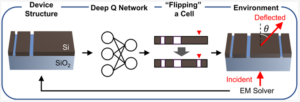
Abstract: The increasing demand on a versatile high-performance metasurface requires a freeform design method that can handle a huge design space, which is many orders f agnitude larger than that of conventional fixed-shape optical structures. In this work, we formulate the designing process of one-dimensional freeform Si metasurface beam deflectors as a reinforcement learning problem to find their optimal structures consistently without requiring any prior metasurface data. During training, a deep Q-network-based agent stochastically explores the device design space around the learned trajectory optimized for deflection efficiency. The devices discovered by the agents show over all improvements in maximum efficiency compared to the ones that state of-the-art baseline methods find at various wavelengths and deflection angles. Furthermore, the efficiencies of the devices generated by agents trained from different neural network initializations have a small variance, demonstrating the robustness of the proposed design method.
Journal Name: Review Article, Nanophotonics (IF 8.449)
Authors : Juho Park, Sanmun Kim, Daniel Wontae Nam, Haejun Chung*, Chan Y. Park* and Min Seok Jang*
Title: Free-form optimization of nanophotonic devices: from classical methods to deep learning
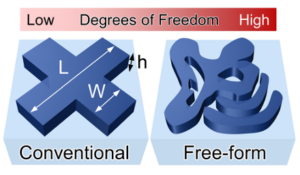
Abstract: Nanophotonic devices have enabled microscopic control of light with an unprecedented spatial resolution by employing subwavelength optical elements that can strongly interact with incident waves. However, to date, most nanophotonic devices have been designed based on fixed-shape optical elements, and a large portion of their design potential has remained unexplored. It is only recently that free-form design schemes have been spotlighted in nanophotonics, offering routes to make a break from conventional design constraints and utilize the full design potential. In this review, we systematically overview the nascent yet rapidly growing field of free-form nanophotonic device design. We attempt to define the term “free-form” in the context of photonic device design, and survey different strategies for free-form optimization of nanophotonic devices spanning from classical methods, adjoint-based methods, to contemporary machine-learning-based approaches.
Journal Name: Nanophotonics (IF 8.449)
Authors : Sanmun Kim, Jeong Min Shin, Jaeho Lee, Chanhyung Park, Songju Lee, Juho Park, Dongjin Seo, Sehong Park, Chan Y. Park and Min Seok Jang*
Title: Inverse design of organic light-emitting diode structure based on deep neural networks
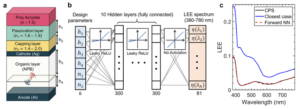
Abstract: The optical properties of thin-film light emitting diodes (LEDs) are strongly dependent on their structures due to light interference inside the devices. However, the complexity of the design space grows exponentially with the number of design parameters, making it challenging to optimize the optical properties of multilayer LEDs with rigorous electromagnetic simulations. In this work, we demonstrate an artificial neural network that can predict the light extraction efficiency of an organic LED structure in 30 ms, which is ∼103 times faster than the rigorous simulation in a single-treaded execution with root-mean squared error of 1.86×10⁻³. The effective inference time per structure is brought down to ∼0.6 μs with unaltered error rate with parallelization. We also show that our neural networks can efficiently solve the inverse problem finding a device design that exhibits the desired light extraction spectrum– within the similar time scale. We investigate the one-to-many mapping issue of the inverse problem and find that the degeneracy can be lifted by incorporating additional emission spectra at different observing angles. Furthermore, the forward neural network is combined with a conventional genetic algorithm to address additional large-scale optimization problems including maximization of light extraction efficiency and minimization of angle dependent color shift. Our approach establishes a platform for tackling computation-heavy optimization tasks with one-time computational cost.