




Professor Myoungsoo Jung of our department has been selected as the first recipient of the Korea Science and Technology Award in 2026 (January).
The Korea Science and Technology Award is presented monthly by the Ministry of Science and ICT to one researcher who has made significant contributions to the advancement of science and technology over the past three years. Professor Jung was chosen as the first awardee of 2026.
Professor Jung was recognized for his work on modular AI data center architectures based on link and memory technologies. His research addresses the limitations of fixed compute and memory configurations in large-scale AI systems by enabling flexible disaggregation and composition of resources using the CXL interconnect standard, improving both cost efficiency and operational efficiency.
He also proposed system architectures that integrate accelerator-centric interconnect technologies such as UALink and NVLink, along with high-bandwidth memory (HBM), into the modular AI data center designs. These designs were documented in technical reports and have received broad attention from both academia and industry.
Professor Jung is the founder of Panmnesia, a KAIST faculty startup, and a member of the ISCA Hall of Fame. Recently, he has been leading the development of a PCIe 6.4/CXL 3.2-based fabric switch, with sample chips currently being evaluated by partner organizations.
This award formally recognizes Professor Jung’s research contributions to the development of next-generation AI infrastructure technologies.


Professor Joo-Young Kim of the School of Electrical Engineering (EE) at KAIST has been selected as a 2026 Incoming Member of the Young Korean Academy of Science and Technology (Y-KAST) under the Korean Academy of Science and Technology (KAST).
Y-KAST is an academy composed of outstanding young scientists under the age of 43, selected based on their exceptional academic achievements.
In particular, the selection process places strong emphasis on research accomplishments achieved as an independent researcher in Korea after earning a doctoral degree, identifying promising next-generation leaders with strong potential to contribute to the advancement of science and technology in Korea.
Professor Kim has been recognized for his pioneering contributions to the field of AI semiconductor systems and architectures, including world-first achievements in AI accelerators and Processing-In-Memory (PIM) semiconductors.
More recently, he has expanded the industrial impact of his research through the development of LPU-based AI semiconductors optimized for large language model (LLM) inference, earning him selection as a member of the Engineering Division of Y-KAST.
With Professor Kim’s selection, KAIST EE now includes six active Y-KAST members—Professor Joo-Young Kim, Steven Euijong Whang, Minsoo Rhu, HyunJoo J. Lee, Min Seok Jang, and Junil Choi—along with two former Y-KAST members, Professors Joonwoo Bae and Changho Suh, whose terms have concluded.
This achievement further underscores KAIST EE’s strong presence and leadership within Korea’s next-generation scientific community.
Established in February 2017, Y-KAST is the only young academy in Korea composed of outstanding scientists under the age of 45. Its members actively engage in science and technology policy initiatives and international collaborations, contributing to the global advancement of science and engineering.


Most major commercial Large Language Models (LLMs), such as Google’s Gemini, utilize a Mixture-of-Experts (MoE) structure. This architecture enhances efficiency by dynamically selecting and using multiple “small AI models (Expert AIs)” depending on input queries. However, the EE research team has revealed for the first time in the world that this very structure can actually become a new security threat.
A joint research team led by Professor Seungwon Shin (School of Electrical Engineering) and Professor Sooel Son (School of Computing) has identified an attack technique that can seriously compromise the safety of LLMs by exploiting the MoE structure. For this research, they received the Distinguished Paper Award at ACSAC 2025, one of the most prestigious international conferences in the field of information security.
ACSAC (Annual Computer Security Applications Conference) is among the most influential international academic conferences in security. This year, only two papers out of all submissions were selected as Distinguished Papers. It is highly unusual for a domestic Korean research team to achieve such a feat in the field of AI security.
In this study, the team systematically analyzed the fundamental security vulnerabilities of the MoE structure. In particular, they demonstrated that even if an attacker does not have direct access to the internal structure of a commercial LLM, the entire model can be induced to generate dangerous responses if just one maliciously manipulated “Expert Model” is distributed through open-source channels and integrated into the system.

To put it simply: even if there is only one “malicious expert” mixed among normal AI experts, that specific expert may be repeatedly selected for processing harmful queries, causing the overall safety of the AI to collapse. A particularly dangerous factor highlighted was that this process causes almost no degradation in model performance, making the problem extremely difficult to detect in advance.
Experimental results showed that the attack technique proposed by the research team could increase the harmful response rate from 0% to up to 80%. They confirmed that the safety of the entire model significantly deteriorates even if only one out of many experts is “infected.”
This research is highly significant as it presents the first new security threat that can occur in the rapidly expanding global open-source-based LLM development environment. Simultaneously, it suggests that verifying the “source and safety of individual expert models” is now essential—not just performance—during the AI model development process.
Professors Seungwon Shin and Sooel Son stated, “Through this study, we have empirically confirmed that the MoE structure, which is spreading rapidly for the sake of efficiency, can become a new security threat. This award is a meaningful achievement that recognizes the importance of AI security on an international level.”
The study involved Ph.D. candidates Jaehan Kim and Mingyoo Song, Dr. Seung Ho Na (currently at Samsung Electronics), Professor Seungwon Shin, and Professor Sooel Son. The results were presented at ACSAC in Hawaii, USA, on December 12, 2025.

Paper Title: MoEvil: Poisoning Experts to Compromise the Safety of Mixture-of-Experts LLMs
GitHub (Open Source): https://github.com/jaehanwork/MoEvil
This research was supported by the Korea Internet & Security Agency (KISA) and the Institute of Information & Communications Technology Planning & Evaluation (IITP) under the Ministry of Science and ICT.


Youngjoon Lee, a Ph.D. candidate from Prof. Joonhyuk Kang’s laboratory at KAIST, received the Best Paper Award at the D2ET Workshop held in conjunction with IEEE BigData 2025.
The D2ET Workshop aims to address the increasing fragmentation of data across the real world—so-called “data islands”—which significantly reduce the utility of big data. To enhance data value and usability, the workshop explores new research directions in next-generation databases and is jointly organized under the A3 Foresight Program, supported by JSPS (Japan), NRF (Korea), and NSFC (China).
The awarded paper proposes a generative AI–powered federated learning plugin designed for robust learning in heterogeneous IoT environments, aligning well with the workshop’s mission of promoting data integration and effective data utilization.


(Right) detected sources, events, directions, and separated results compared with ground truth>
The researchers demonstrated that a single model performing multiple tasks yields improved performance for each task. They further introduced a Chain of Inference approach, in which temporal coherence among separated source signals, detected classes, and directional patterns is analyzed to refine the inference results, thereby significantly improving the robustness of auditory AI systems.


Professor Sanghyeon Kim’s research team from our undergraduate School of Electrical Engineering has received the IEEE Paul Rappaport Award on December 8, 2025, in recognition of their achievements in developing Complementary Field-Effect Transistor (CFET) technology, which is gaining attention as a next-generation transistor architecture.
The IEEE Paul Rappaport Award is presented to the best paper selected from among the papers published over the previous year in IEEE Transactions on Electron Devices (TED), a leading journal in the field of semiconductor devices. This year’s award was chosen from a total of 1,202 papers published in 2024, and this achievement marks the first time that a university in Korea has received this award.
The awarded paper, titled “Heterogeneous 3-D Sequential CFETs With Ge (110) Nanosheet p-FETs on Si (100) Bulk n-FETs,” was led by Dr. Seong Kwang Kim (Ph.D. graduate in 2023 from the School of Electrical Engineering), and was conducted in collaboration with Professor Byung-Jin Cho’s laboratory. The study is significant in that it demonstrated a direction for overcoming the structural issue of CFETs—namely, the low performance of p-FETs—by integrating, as the upper device, a Ge channel with a (110) crystal orientation.
In addition, all stages of device design, fabrication, and evaluation were carried out entirely at KAIST, which represents the high research standards and infrastructure of the School of Electrical Engineering.
Dr. Seong Kwang Kim stated, “Since my Ph.D., and continuing now as I work in industry, I have been continually developing three-dimensional stacked devices. There remain many challenges to overcome in order to achieve mass production of three-dimensional stacked devices, and I will continue researching and taking on these challenges to contribute to the development of semiconductor technology in Korea.”
Related Link


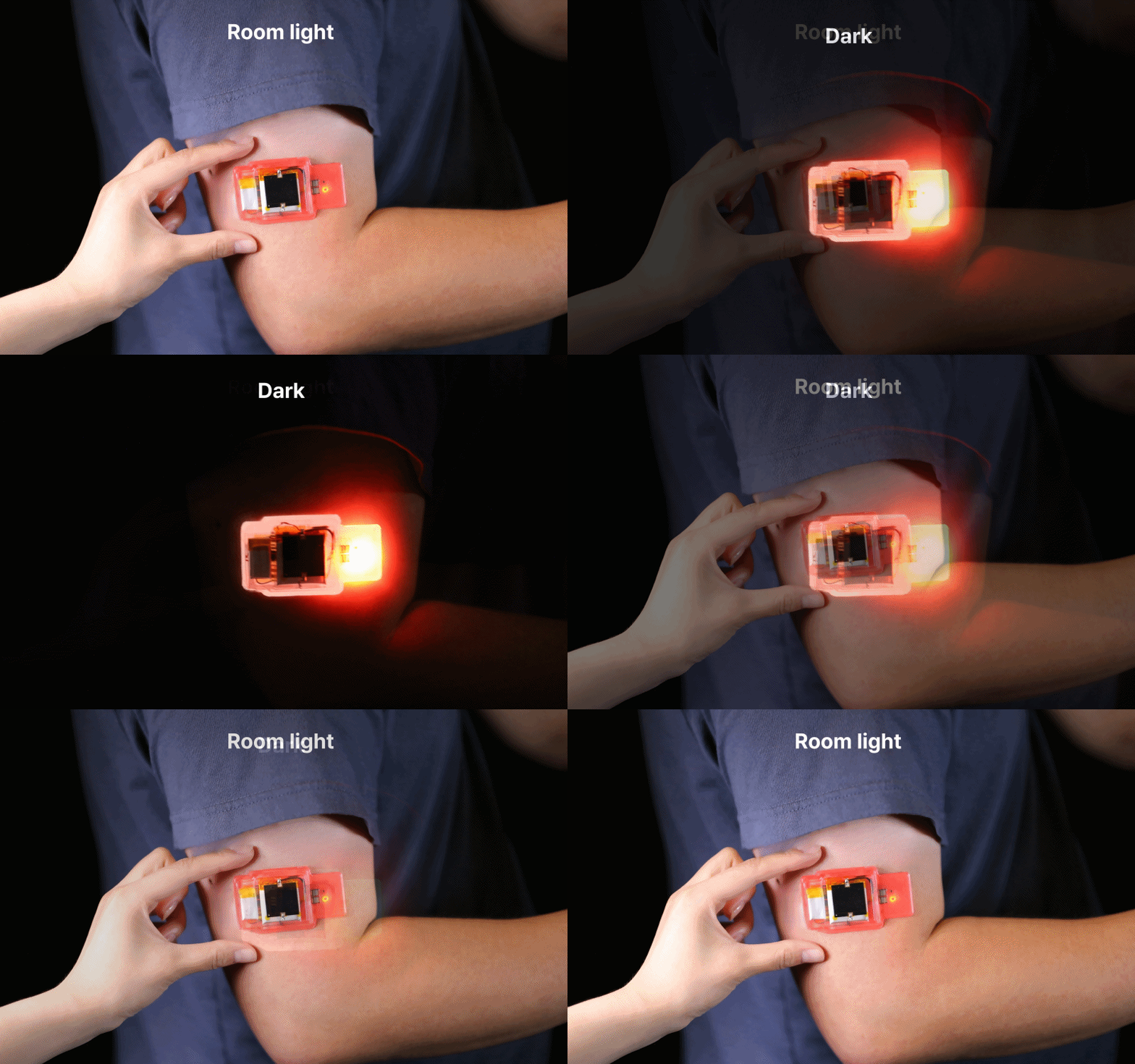
A joint research team led by Professor Kyung Cheol Choi from the School of Electrical Engineering at KAIST and Dr. Ja Wook Koo and Dr. Hyang Sook Hoe from the Korea Brain Research Institute (KBRI) developed a uniform-illuminance, three-color OLED photostimulation platform and confirmed that red 40-Hz light was the most effective among blue, green, and red lights in improving Alzheimer’s pathology and memory function.
To overcome the structural limitations of conventional LEDs—such as brightness imbalance, heat generation risk, and variability caused by animal movement—the researchers developed an OLED-based photostimulation platform that emits light uniformly. Using this platform, they compared white, red, green, and blue light under identical conditions (40-Hz frequency, brightness, and exposure time) and found that red 40-Hz light produced the most significant improvement.
In an early-stage (3-month-old) Alzheimer’s animal model, improvement in pathology and memory was observed after only two days of stimulation. When early Alzheimer’s model mice were exposed to one hour of light per day for two days, both white and red light improved long-term memory. Additionally, the amount of amyloid-β (Aβ) plaques—protein aggregates known as a major factor in Alzheimer’s disease—was reduced in key brain regions such as the hippocampus, and levels of the plaque-clearing enzyme ADAM17 increased.
This indicates that even very short periods of light stimulation can reduce harmful proteins in the brain and improve memory function. In particular, with red light, the inflammatory cytokine IL-1β, known to exacerbate inflammation and contribute to Alzheimer’s progression, decreased significantly, demonstrating an anti-inflammatory effect.
Moreover, the more plaque was reduced, the greater the improvement in memory—direct evidence that pathological improvement leads to cognitive enhancement.
In the mid-stage (6-month-old) Alzheimer’s model, statistically significant pathological improvement was seen only with red light. In a two-week long-term stimulation experiment under the same conditions, both white and red light improved memory, but a statistically meaningful.

Differences at the molecular level were also clear. Under red light, levels of ADAM17 (which helps remove plaques) increased, while levels of BACE1, an enzyme responsible for producing plaques, decreased—demonstrating a dual effect of both inhibiting plaque formation and promoting plaque removal. In contrast, white light only lowered BACE1, showing more limited therapeutic effects compared to red light.
This scientifically identifies that the color of light is a key factor determining therapeutic efficacy.
To determine which neural circuits were activated by light stimulation, the team analyzed the expression of c-Fos, an immediate-early gene that is activated when neurons fire.
They found activation throughout the visual–memory circuit, extending from the visual cortex → thalamus → hippocampus, providing direct neurological evidence that light stimulation awakens the visual pathway, enhancing hippocampal function and memory.
Thanks to the uniform-illuminance OLED platform, light was evenly delivered regardless of animal movement, ensuring stable experimental results and high reproducibility across repeated tests.
This study is the first to demonstrate that cognitive function can be improved using only light, without drugs, and that Alzheimer’s pathological markers can be regulated through combinations of light color, frequency, and duration.
The OLED platform developed in this study allows fine control over color, brightness, flicker ratio, and exposure time, making it suitable for personalized stimulation design in future human clinical research.
The research team plans to expand conditions such as stimulation intensity, energy, duration, and combined visual–auditory stimulation, aiming toward clinical-stage development.
Dr. Byeongju Noh (from Professor Kyung Cheol Choi’s research team) said, “This study experimentally demonstrates the importance of color standardization and confirms that red OLED is the key color that activates ADAM17 and suppresses BACE1 across disease stages.”
Professor Kyung Cheol Choi emphasized, “Our uniform-illuminance OLED platform overcomes the structural limitations of traditional LEDs and enables high reproducibility and safe evaluation. We expect wearable RED OLED electroceuticals for everyday use to present a new therapeutic paradigm for Alzheimer’s disease.”
The research findings were published online on October 25 in ACS Biomaterials Science & Engineering, a leading international journal in biomedical and materials science.
※ Paper Title: Color Dependence of OLED Phototherapy for Cognitive Function and Beta-Amyloid Reduction through ADAM17 and BACE1 DOI: https://pubs.acs.org/doi/full/10.1021/acsbiomaterials.5c01162
※ Co-authors:
Byeongju Noh, Hyun-Ju Lee, Jiyun Lee, Jiyun Lee, Ji-Eun Lee, Bitna Joo, Young-Hun Jung, Minwoo Park, Sora Kang, Seokjun Oh, Jeong-Woo Hwang, Dae-Si Kang, Yongmin Jeon, So-Min Lee, Hyang Sook Hoe, Ja Wook Koo, Kyung Cheol Choi
This research was supported by the National Research Foundation of Korea and the National IT Industry Promotion Agency under the Ministry of Science and ICT, and the Korea Brain Research Institute Basic Research Program. (2017R1A5A1014708, 2022M3E5E9018226, H0501-25-1001, 25-BR-02-02, 25-BR-02-04)