


A new solution that could overcome the limitations of conventional hair-loss treatments is emerging. Heavy and rigid helmet-type phototherapy devices may soon become a thing of the past. A joint research team has developed a hat-like, wearable OLED-based phototherapy device and demonstrated that it can suppress hair-follicle cell aging by up to 92%, a key factor in hair-loss progression.
A research team led by Professor Kyung Cheol Choi of the School of Electrical Engineering, in collaboration with Professor Yun Chi’s group at the Hong Kong University of Science and Technology, has developed a non-invasive* hair-loss treatment technology using a textile-like, flexible wearable platform integrated with specially designed OLED light sources. *Non-invasive treatment refers to therapies that do not involve skin incisions or direct physical damage to the body.
Although drug-based treatments for hair loss have been known to be effective, concerns over side effects from long-term use have driven interest in safer alternatives such as phototherapy. However, existing phototherapy devices for hair loss are typically bulky, rigid helmet-type systems, limiting their use to indoor environments. Moreover, because they rely on point light sources such as LEDs or lasers, it has been difficult to deliver uniform light irradiation across the entire scalp.
To address these challenges, the researchers replaced point light sources with area-emitting OLEDs, which emit light uniformly over a wide surface. In particular, they integrated near-infrared (NIR) OLEDs into a soft, fabric-like material that can be worn as a cap. This design allows the light source to naturally conform to the contours of the scalp, delivering even optical stimulation over the entire scalp.
Beyond wearable design, the study focused on suppressing hair-follicle cell aging, a central driver of hair-loss progression. The key achievement of this work lies not only in realizing a wearable device, but also in precisely tailoring the wavelength of light to maximize therapeutic efficacy.
Recognizing that cellular responses vary depending on light wavelength, the team extended wavelength-control techniques originally developed for display OLEDs to therapeutic applications. As a result, they fabricated customized OLEDs that selectively emit near-infrared light in the 730–740 nm range, which is optimal for activating dermal papilla cells—critical cells located at the base of hair follicles that regulate hair growth.
The effectiveness of the developed NIR OLEDs was validated through experiments using human dermal papilla cells (hDPCs). Cellular aging analysis showed that NIR OLED irradiation suppressed cell aging by approximately 92% compared with the control group, outperforming conventional red-light irradiation conditions.
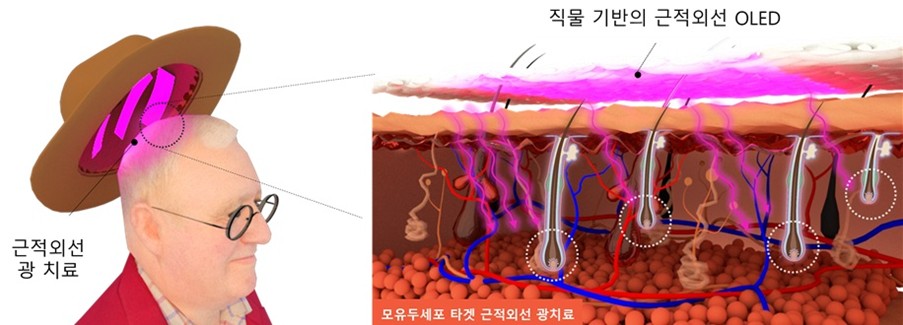
First author Dr. Eun Hae Cho commented, “Instead of rigid, helmet-type point-light devices, we propose a wearable phototherapy platform that can be used in daily life by implementing soft, textile-based OLEDs in a cap form. A key outcome of this study is demonstrating that precisely engineered light wavelengths can effectively suppress hair-follicle cell aging.”
Professor Kyung Cheol Choi added, “Because OLEDs are thin and flexible, they can closely conform to the curved surface of the scalp, delivering uniform light stimulation across the entire area. Going forward, we plan to verify safety and efficacy through preclinical studies and progressively evaluate the potential for real therapeutic applications.”
This research was led by Dr. Eun Hae Cho of the KAIST School of Electrical Engineering as first author and was published online on January 10 in the international journal Nature Communications.
※ Paper title: “Wearable Textile-Based Phototherapy Platform With Customized NIR OLEDs Toward Non-Invasive Hair Loss Treatment”
※ DOI: https://doi.org/10.1038/s41467-025-68258-3
※ Co-authors: Eun Hae Cho, Jingi An, Yun Chi, Kyung Cheol Choi

This research was conducted with the support of the Ministry of Science and ICT through the National Research Foundation of Korea (NRF) under the National R&D Program (Future-Oriented R&D Convergence Science and Technology Development Program (Bridge Convergence Research): Development of a skin patch for wound treatment integrating bio-tissue adhesive patches with drug delivery and phototherapy OLED therapy, the Technology Innovation Program supported by the Ministry of Trade, Industry and Energy (development of substrate materials stretchable by more than 50% for stretchable displays), and the BK21 FOUR Program of the Ministry of Science and ICT (Connected AI Education & Research Program for Industry and Society Innovation, School of Electrical Engineering, KAIST). (2021M3C1C3097646, 20017569, 4120200113769)


Ji-Hoon Kim and Hyeonggon Ryu have been appointed as assistant professors at leading universities in Korea. They are Ph.D. candidates from Prof. Joon Son Chung’s Multimodal AI Lab in the School of Electrical Engineering, KAIST, and will receive their Ph.D. degrees in February 2026.
Ji-Hoon Kim has been appointed as an Assistant Professor at the Graduate School of Advanced Imaging Science, Multimedia & Film at Chung-Ang University, effective March 1, 2026. During his doctoral studies, he conducted research on human-centric multimodal artificial intelligence and published research papers in venues such as IEEE Transactions on Audio, Speech and Language Processing (TASLP), IEEE/CVF Conference on Computer Vision and Pattern Recognition (CVPR), and the AAAI Conference on Artificial Intelligence (AAAI). He plans to continue his research on multimodal AI technologies for natural interaction between humans and artificial intelligence.
Hyeonggon Ryu has been appointed as an Assistant Professor in the Department of Language & AI at Hankuk University of Foreign Studies, effective March 1, 2026. His research focused on audio-visual multimodal artificial intelligence, and he has published research papers in IEEE Transactions on Pattern Analysis and Machine Intelligence (TPAMI), IEEE/CVF Conference on Computer Vision and Pattern Recognition (CVPR), and the CVF International Conference on Computer Vision (ICCV). He plans to pursue further research on audio-visual multimodal AI, contributing to both academic and industrial developments.
These appointments reflect the outcomes of Prof. Joon Son Chung’s lab, which fosters an environment that encourages independent research and active participation in international academic activities in the field of multimodal artificial intelligence.

Dr. Sunjae Yoon, a Ph.D. graduate of the Artificial Intelligence & Machine Learning Lab. (U-AIM) at the School of Electrical Engineering, KAIST (Advisor: Professor Chang Dong Yoo), has been appointed as a tenure-track Assistant Professor in the Department of Artificial Intelligence, College of Software, Chung-Ang University, effective March 1, 2026.
Dr. Yoon received his Ph.D. degree from the School of Electrical Engineering, KAIST in February 2025 and is currently serving as a Postdoctoral Researcher at the KAIST Institute for Information Technology Convergence.
His primary research focus is Generative Artificial Intelligence, particularly in diffusion model-based video editing. His doctoral dissertation, titled “Diffusion Model-based Video Editing,” was recognized with the Outstanding Ph.D. Dissertation Award. He has also published multiple research papers at leading international conferences in artificial intelligence, including NeurIPS, ICML, and ICCV.
The research group led by Professor Chang Dong Yoo has conducted extensive research on generative artificial intelligence across diverse modalities such as image, video, audio, and natural language. Building on these research achievements, the lab has successfully produced outstanding scholars who have joined various academic institutions, including Seoul National University, Korea University, Ulsan National Institute of Science and Technology (UNIST), Chung-Ang University, Gangneung-Wonju National University, and Pai Chai University.
The School of Electrical Engineering, KAIST congratulates Dr. Yoon on this significant achievement and looks forward to his continued success and contributions to the field of artificial intelligence

Shilong Zhang, Ph.D. Candidate, Professor Youngsoo Shin’s Research Lab (DT Lab), Winner of the First Place Photronics Best Student Presentation Award at SPIE Photomask Technology 2025
Shilong Zhang, a Ph.D. candidate from Professor Youngsoo Shin’s research group (KAIST DT Lab) in the School of Electrical Engineering, has won the First Place Photronics Best Student Presentation Award at SPIE Photomask Technology + EUV Lithography 2025, held from September 22 to 26 in Monterey, California, USA.
SPIE Photomask Technology + EUV Lithography is a premier international symposium where professionals and academics from the semiconductor industry gather to present and discuss the latest advancements in photolithography mask technology. The Photronics Best Student Presentation Award, sponsored by Photronics, Inc., is established to encourage students working in fields related to photomasks and EUV lithography. The first place winner receives a $1,500 prize.
Zhang’s award-winning paper, titled “Integrated Curvilinear OPC and SRAF Optimization through Reinforcement Learning,” proposes a reinforcement learning-based method to co-optimize curvilinear sub-resolution assist features (SRAFs) and curvilinear main patterns for advanced semiconductor lithography. The proposed method reduces maximum vertex placement error (VPE) by 7.6% and maximum process variation band (PVB) width by 23.0% compared to conventional curvilinear OPC with fixed SRAFs, demonstrating significant improvements in both pattern fidelity and process window robustness.
For details, refer to the link below:
https://spie.org/conferences-and-exhibitions/photomask-technology-and-extreme-ultraviolet-lithography/program/conferences/awards


A group research project from the Quantum Device Lab at the School of Electrical Engineering, KAIST, led by Professor Young-Ik Sohn, has been selected as a new 2025 project under the Quantum Science and Technology Flagship Program. The project is titled “All-Photonic Quantum Repeaters Based on Chip-Scale Fusion Multiplexing and Quantum-Dot-Based Deterministic Linear Cluster States.”
This research aims to develop quantum repeaters, a core enabling system essential for long-distance quantum communication. In particular, it distinguishes itself from conventional approaches by pursuing an all-photonic quantum repeater, which relies exclusively on photonic qubits without employing matter-based qubits such as electron spins. The all-photonic quantum repeater is an emerging research paradigm whose theoretical foundation has only recently been established, and it is gaining significant attention as a key candidate technology for next-generation quantum networks.
The conceptual architecture of an all-photonic quantum repeater consists of repeated units composed of a Repeater Graph State (RGS) node, which generates entangled photons, and a measurement node.

By eliminating matter-based qubits, this novel approach offers a crucial advantage: the potential for large-scale manufacturing using only existing semiconductor fabrication technologies. As a result, the proposed technology is considered to possess strong potential to evolve into an industry-standard quantum repeater platform in the future.
To achieve these ambitious research objectives, an industry–academia consortium has been formed, led by KAIST and joined by domestic component companies Fiberpro and Quad. In addition, an international collaborative research team has been established with Quandela, a world-leading French photonic quantum computing company. The Quandela research team will closely collaborate to apply their state-of-the-art entangled photon generation technology as a key component of the quantum repeater system.
The realization of quantum repeaters requires not only quantum photonic chip technologies, but also system-level operational design, application-specific integrated circuits (ASICs) for high-speed multiplexing, and ultra-low-loss packaging technologies, necessitating highly interdisciplinary research efforts. Accordingly, Professor Joonwoo Bae and Professor Wanyeong Jung from the School of Electrical Engineering, KAIST, along with Professor Donguk Nam from the Department of Mechanical Engineering, are participating as co-investigators, contributing their expertise across these domains.
This project is conducted as part of the Quantum Science and Technology Flagship Program, a national quantum initiative led by the Ministry of Science and ICT of Korea. The program will be carried out over approximately eight years through 2032, with a total budget of KRW 645.4 billion, pursuing mission-oriented research and development across three major areas: quantum computing, quantum communication, and quantum sensing. The KAIST research team has been selected for one of the five core projects in the quantum communication domain and will receive approximately KRW 12.8 billion in research funding.
If the quantum repeater is successfully realized through this research, it is expected to extend current quantum key distribution (QKD) technologies—currently limited to distances of around 100 km—to a global scale, thereby making a decisive contribution toward the realization of the quantum internet.


Dr. Hyesang Cho, a graduate of the Intelligent Communication Systems Lab. (ICL) in the School of Electrical Engineering (Advisor: Prof. Junil Choi), has been appointed as an Assistant Professor in the Dept. of Electrical and Electronic Engineering at Inha University, effective March 1, 2026.
Dr. Hyesang Cho received a Ph.D. degree from the School of Electrical Engineering at KAIST in February 2024, and has since served as a postdoctoral researcher at the Institute of Information Electronics, KAIST.
His main research focuses on the development of next-generation wireless communication systems. He has published numerous papers in top-tier journals such as IEEE Transactions on Wireless Communications and IEEE Transactions on Communications, and has received multiple best paper awards, demonstrating the excellence of his research.
Moving forward, he will continue to concentrate on advancing next-generation wireless communication systems and contribute to both academic and industrial development.


We are pleased to announce that Professor Iksung Kang has joined the School of Electrical Engineering as of January 26, 2026. We warmly welcome him to our school.
Professor Kang’s temporary office is located in Room 1410, Saeneul-Dong. His research focuses on the design of intelligent imaging systems that integrate physics-based models with machine learning. He is particularly interested in computational imaging technologies for biomedical microscopy, neuroscience, and metrology. By combining the physical principles of optical systems with deep learning, he proposes novel approaches to overcome the limitations of conventional imaging techniques.
Through inverse problem modeling that efficiently reconstructs high-dimensional information from measured signals, as well as end-to-end imaging system development that integrates sensing, physics, and learning, Professor Kang aims to realize next-generation imaging technologies that are both highly accurate and broadly accessible.
For more detailed information about Professor Kang’s research, please visit his website below.
Website: https: https://iksungk.github.io/
<Academic and Professional Profile>
Major Field
- Physics- and Learning-driven Imaging System Design
- Computational Imaging (for Biomedical Microscopy, Neuroscience, and Metrology)
Educational Career
- Bachelor Degree: 2017, Seoul National University
- Master Degree: 2020, MIT
- Doctoral Degree: 2022, MIT
Career
- Sep. 2025 – Jan. 2026: Assistant Professor, Yonsei University
- Jul. 2022 – Jun. 2025: Postdoctoral Researcher, UC Berkeley
Publications
- Optical segmentation-based compressed readout of neuronal voltage dynamics, Nature Communications, 2025
- Coordinate-based neural representations for computational adaptive optics in widefield microscopy, Nature Machine Intelligence, 2024
- Accelerated deep self-supervised ptycho-laminography for three-dimensional nanoscale imaging of integrated circuits, Optica, 2023
- Attentional Ptycho-Tomography (APT) for three-dimensional nanoscale X-ray imaging with minimal data acquisition and computation time, Light: Science & Applications, 2023
- Simultaneous spectral recovery and CMOS micro-LED holography with an untrained deep neural network, Optica, 2022
- Dynamical machine learning volumetric reconstruction of objects’ interiors from limited angular views, Light: Science & Applications, 2021
Assigned Curricular Plan
- EE49904: Special Topics in Electrical Engineering
- <Computational Imaging>
- Other signal-related courses (e.g., signal/image processing, optical imaging)
Vision
- Develop intelligent imaging systems that seamlessly integrate physics and machine learning with system-level design to make advanced imaging more accessible.
Research Plan
- Generalizable Imaging Architectures: Create unified imaging frameworks that generalize across sensing modalities and sample types.
- Imaging-driven Inverse Intelligence: Build imaging-driven inverse modeling frameworks that connect measurements to high-level system understanding.
- End-to-end Intelligent Imaging: Develop end-to-end imaging systems that integrate sensing, physics, and learning for task-aware inference.


Professor Myoungsoo Jung of the School of Electrical Engineering has been inducted into the IEEE HPCA Hall of Fame.
HPCA (The International Symposium on High-Performance Computer Architecture) is one of the leading international conferences in computer architecture, focusing on advances in high-performance computing systems. The HPCA Hall of Fame recognizes researchers who have made sustained contributions to the field by publishing eight or more papers at the conference.
Professor Jung was selected for this honor following the publication of his recent paper, “AutoGNN: End-to-End Hardware-Driven Graph Preprocessing for Enhanced GNN Performance.”
Having previously been inducted into the IEEE/ACM ISCA Hall of Fame in 2025, Professor Jung has now been recognized by the Hall of Fame of two major top-tier conferences in computer architecture.
Professor Jung leads the Computer Architecture and Memory/Storage Systems Laboratory (CAMELab) and has conducted long-term research in interconnect technologies and memory/storage systems. He has authored a total of 145 papers published at major international conferences, including SOSP, OSDI, ISCA, MICRO, ASPLOS, HPCA, ATC, FAST, and SC. In 2022, he founded Panmnesia, a faculty startup developing link solutions to improve the efficiency of AI data centers, contributing to both academic and industrial research. In recognition of his continued contributions to science and technology, he was also selected as the first recipient of the 2026 Korea Science and Technology Award.
Professor Jung’s AutoGNN paper will be presented at HPCA 2026, to be held in Sydney, Australia, from January 31 to February 4.
This Hall of Fame induction reflects the sustained efforts of Professor Jung and his collaborators toward advancing computer system design.