


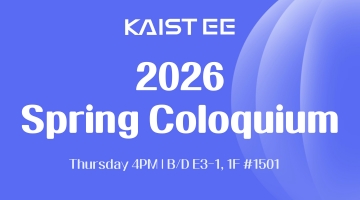

The Spring 2026 Colloquium Series of the KAIST School of Electrical Engineering began on March 12, 2026.
The first speaker, Jihoon Kim, Chief Research Officer of FuriosaAI, delivered a talk titled “Unlock Furiosa RNGD’s Full Potential with Kernel Programming.” In his lecture, he introduced how the dataflow-based architecture of Furiosa RNGD and its kernel programming model enable developers to directly control hardware, making it possible to build high-performance AI inference infrastructure that overcomes the limitations of conventional GPUs. The talk drew significant interest from the audience.
Upcoming lectures will include talks on quantum computing systems by Director Kihwan Kim of the Institute for Basic Science (IBS) (Center for Trapped Ion Quantum Science) and Professor Hui Khoon Ng of the National University of Singapore. In addition, Samsung Display and Samsung Electronics executives Cheol Lae Roh, Jungbae Lee, and Huiwon Je will be invited to discuss technological innovation and industrial applications in AI driven innovation in display manufacturing, AI driven by semiconductor technology and next-generation communications (6G), respectively.
According to Professor Minkyu Je, who organizes the colloquium series, the program will also feature lectures by Prof. Youngjoo Lee, a recently appointed faculty member of the School of EE as well as Prof. Jooyoung Kim, a faculty member involved in entrepreneurship. He encouraged active participation from both students and faculty.
The colloquium lectures are held Thursday at 4:00 PM in Lecture Halls 1 of the Information and Electronics Building (E3-1).


Blood flow is a vital signal of life. When this flow slows down or becomes unstable, it can lead to cardiovascular diseases and shock. However, accurately measuring blood flow has traditionally required hospital equipment. Prof. Kyeongha Kwon’s research team at the School of Electrical Engineering has developed a wireless electronic patch that can measure blood flow in real time simply by attaching it to the skin.
The wireless wearable blood flow monitoring system developed by Prof. Kwon’s team combines deep learning (AI) with multilayer thermal sensing technology. This device can simultaneously measure blood flow velocity and blood vessel depth without directly contacting the vessels (a non-invasive method). Because sensor signals vary depending on how deeply the blood vessels are located beneath the skin, depth information is a key variable for accurately calculating blood flow.
Previously, ultrasound or optical methods were mainly used, but these approaches had limitations, as the equipment was large or the accuracy decreased depending on vessel depth. To overcome these limitations, the research team focused on the fact that when blood flows, subtle heat transfer occurs in the surrounding tissue.

The team developed a “multilayer thermal sensing” technology that analyzes heat transfer pathways three-dimensionally by placing temperature sensors at different depths. By applying AI algorithms, they succeeded in separating and extracting both the depth of blood vessels and the actual blood flow velocity in real time from complex body temperature distributions. Through AI-based analysis, the system can accurately distinguish between vascular depth and actual blood flow velocity within complex temperature patterns of the body.
Experimental results showed that the system successfully measured blood flow velocities in the range of 1–10 mm/s with an error within 0.12 mm/s, and blood vessel depths in the range of 1–2 mm with an error within 0.07 mm. This level of error is smaller than the thickness of a human hair and represents a degree of precision that is difficult to achieve with typical wearable devices.

In particular, when this technology is combined with photoplethysmography (PPG) sensors used in smartwatches, the error in blood pressure measurement can be reduced by up to 72.6%. This indicates that smartwatch-based blood pressure measurements could become much closer to those obtained with hospital equipment. In other words, this achievement can significantly improve the reliability of wearable devices.
This electronic patch can be used in emergency medical settings to detect changes in a patient’s condition in real time. It may also be applied to personalized health management for patients with hypertension or diabetes and to the early detection of acute warning signs such as shock.
Prof. Kyeongha Kwon stated, “This technology provides a fundamental platform for measuring blood flow and blood pressure more accurately, and when combined with smartwatches, it will elevate the level of everyday health monitoring.”
The study was led by Young Min Sim, an integrated M.S.–Ph.D. student, as the first author. The research results were published on February 6 in the world-renowned journal Science Advances.
Paper title: Deep learning–integrated multilayer thermal gradient sensing platform for real-time blood flow monitoring
DOI: 10.1126/sciadv.aea8902
Meanwhile, this research was supported by the Samsung Advanced Institute of Technology (SAIT), the National Research Foundation of Korea (NRF) Outstanding Young Researcher Program (2022R1C1C1010555), the Regional Innovation Leading Research Center (2020R1A5A8018367), the BK21 FOUR Program, and the Artificial Intelligence Semiconductor Graduate School program funded by the Institute of Information & Communications Technology Planning & Evaluation (IITP).


Shilong Zhang, a Ph.D. candidate from Professor Youngsoo Shin’s research group (DT Lab) in the School of Electrical Engineering, has been selected as the recipient of the 2026 SPIE Nick Cobb Memorial Scholarship, receiving a $10,000 award.
The SPIE Nick Cobb Memorial Scholarship is awarded to an outstanding graduate student studying advanced lithography or a related field, jointly funded by Siemens EDA and SPIE. Nick Cobb was a Senior Member of SPIE and Chief Engineer at Mentor Graphics (now Siemens EDA), whose pioneering contributions enabled optical and process proximity correction (OPC) for IC manufacturing.
Zhang has been recognized for his outstanding research accomplishments, including winning the First Place Photronics Best Student Presentation Award at SPIE Photomask Technology + EUV Lithography 2025 and the ISE President Best Paper Award at the 2024 International SoC Design Conference. He was honored during the 2026 SPIE Advanced Lithography + Patterning conference, held February 22–26 in San Jose, California, where he also presented his paper titled “Etch proximity correction for curvilinear layout: Curve sampling with ML etch bias model.”
For details, refer to the link below:
https://spie.org/news/2026-spie-nick-cobb-memorial-scholarship-recipient-announced


Dr. Dongheon Lee from Professor Jung-Woo Choi’s research group will be appointed as an Assistant Professor in the Division of Electronic, Information and Communication Engineering at Pukyong National University, effective September 2026.
Dr. Lee earned his Ph.D. in February 2025, dedicating his research to artificial intelligence models for spatial acoustic analysis. During his doctoral studies, he conducted in-depth research on an integrated acoustic analysis system encompassing speech enhancement, sound source separation, noise reduction, direction-of-arrival estimation, and classification, utilizing spatial acoustic signals collected through multi-channel microphones.
In particular, he presented the “DeepASA” model at NeurIPS 2025, a unified spatial acoustic AI framework capable of comprehensively inferring all related tasks within a single model. In addition, he developed innovative multi-channel speech enhancement models and achieved outstanding research accomplishments by publishing a total of 12 first-author papers in leading conferences and journals in speech and audio, including ICASSP, INTERSPEECH, and IEEE Transactions on Audio, Speech, and Language Processing (TASLP). Furthermore, he demonstrated his practical technological expertise by leading his team to victory in DCASE Task 4, the 2025 international challenge on acoustic scene analysis.
We sincerely congratulate Dr. Dongheon Lee as he embarks on his career as an independent researcher. We wish him continued success in advancing the field of acoustic artificial intelligence and in emerging as a leading scholar in world-class research.


Dr. Kyeongwon Jeong, Dr. Yoontae Jung, and Dr. Edward Jongyoon Choi, Ph.D. graduates from Prof. Minkyu Je’s research group, have been appointed as Assistant Professors at the School of Integrated Technology, Yonsei University; the Department of Semiconductor Engineering, Kyung Hee University; and the Division of Electronic and Semiconductor Engineering, Ewha Womans University, respectively.
Dr. Kyeongwon Jeong received his Ph.D. in February 2023 and subsequently worked as a postdoctoral researcher at ETH Zurich and IBM Research in Zurich, Switzerland. His research focuses on mixed-signal circuit design and intelligent sensor interfaces, including ADCs, neural and ultrasound systems, in-memory computing hardware accelerators, and Ising machine architectures.
Dr. Yoontae Jung earned his B.S., M.S., and Ph.D. degrees (2024) from KAIST. Since 2024, he has been conducting research on neural interface ICs at imec in Leuven, Belgium. His research interests include biomedical ICs, neural ICs, sensor interface ICs for physical AI, and processing-in-memory (PIM) technologies.
Dr. Edward Jongyoon Choi received his Ph.D. in February 2025 and subsequently joined Annapurna Labs (Amazon Web Services) in Silicon Valley as a Circuit Design Engineer, where he contributed to the design of the AWS Trainium accelerator. His primary research interests include AI/ML accelerator design, algorithm–hardware co-design, and processing-in-memory circuit design, with a focus on circuit and architecture design for high-performance, low-power intelligent semiconductor systems.
We look forward to their continued contributions to academia through excellence in research and education and to their impact on the advancement of semiconductor and advanced engineering research worldwide.


Gichan Yun, a Ph.D. candidate from the research group of Prof. Minkyu Je in the School of Electrical Engineering, has been selected as a recipient of the 2025–2026 IEEE Solid-State Circuits Society (SSCS) Predoctoral Achievement Award.
The SSCS Predoctoral Achievement Award is a prestigious program presented to outstanding Ph.D. students worldwide who have demonstrated exceptional research accomplishments in solid-state circuits and systems. Each year, only a limited number of students are selected; this year, Gichan Yun was named among just 30 awardees globally.
Gichan Yun has published a total of 23 international papers, including two ISSCC papers as first author or co–first author. Among these, 17 papers have been published in SSCS-sponsored journals and conferences. His contributions to low-power, high-resolution sensor interface design and his strong academic achievements were key factors leading to this distinguished recognition.


We are delighted to share that three Ph.D. alumni from the Integrated Organic Electronics Laboratory (Advisor: Prof. Seunghyup Yoo) — Dr. Marco Alban-Paccha, Dr. Hyung Suk Kim, and Dr. Jee Hoon Sim — have been appointed as Assistant Professors at the School of Electrical and Electronic Engineering, University College Dublin; the Department of Semiconductor Engineering, Gachon University; and the Department of Electronic Engineering, Soonchunhyang University, respectively.
After earning his Ph.D. in 2022, Dr. Marco Alban-Paccha worked as a postdoctoral researcher in Prof. George Malliaras’s group the University of Cambridge, UK. His research focuses on wearable biomedical technologies, with particular interest in clinically meaningful multimodal sensing that spans device fabrication, system-level implementation, and AI-based biosignal analysis.
Dr. Hyungseok Kim, who also received his Ph.D. in 2022, served as a postdoctoral researcher in Prof. Chihaya Adachi’s group at Kyushu University and later as a researcher at Samsung Display. His primary research area is OLED device physics, and he has published impactful work in leading journals such as Science Advances and Nature Communications.
Dr. Jihoon Shim graduated in 2023 and subsequently worked in the Display Group of MX Division at Samsung Electronics. During his doctoral studies, he published outstanding research in Science Advances on biomedical applications based on highly flexible OLED technologies.
We sincerely congratulate these three alumni on their new appointments and look forward to seeing them continue to excel and make meaningful contributions in research, education, and service to society.


Se Jin Park, a doctoral researcher from Professor Yong Man Ro’s laboratory, received his Ph.D. in February 2026 and has been appointed as an Assistant Professor in the Department of Electronic Engineering at Kyung Hee University as of March 2026. Throughout her doctoral studies, Park has been conducting research on multimodal artificial intelligence that integrates speech, vision, and language, with the goal of enabling natural and seamless interaction between humans and AI.
Park has been developing methods for visual–acoustic representation learning, modeling long- and short-term conversational context, and leveraging both linguistic and nonverbal cues from human interaction for dialogue understanding and generation. Her research achievements have been recognized internationally. She has presented a total of 13 papers at top-tier conferences such as ICML, ACL, CVPR, AAAI, and ICASSP, and her work has been selected for several prestigious distinctions, including the ACL Outstanding Paper Award, ICML Oral, CVPR Highlight, ACL Oral, and AAAI Oral. Through these accomplishments, Park has established herself as a competitive researcher in the fields of multimodal AI and conversational intelligence.
Park has expressed her intention to continue pursuing research on conversational intelligence that enables AI systems to collaborate and communicate effectively with real users in complex interaction environments that combine speech, vision, and language. Our school sincerely congratulates her on this new beginning and looks forward to her future contributions in education, research, and industry collaboration at Kyung Hee University.