










Dr. Yongwoo Lee, a postdoctoral researcher in the School of Electrical Engineering at KAIST, has been selected for the individual research track of the “Post-Doc. Research Fellowship” funded by the Ministry of Education and the National Research Foundation of Korea.
The program is designed to foster the next generation of researchers and strengthen national research capabilities. It provides multi-year research funding to promising postdoctoral researchers, enabling them to conduct innovative and challenging research under the mentorship of faculty members and grow as independent researchers.
In the 2026 individual research track, a total of 30 projects were selected nationwide in South Korea. Dr. Lee’s project is the only KAIST project selected in the ICT and Convergence Research Division, among three KAIST projects selected in total. This recognition highlights the importance and broad potential of advanced semiconductor packaging technologies. Under the mentorship of Prof. Jimin Kwon (School of Electrical Engineering & Department of AI Systems, KAIST), Dr. Lee will conduct research on “Development of Glass Substrate-Based mmWave* GaN** RF Power Amplifier*** Embedded Packaging Technology for Physical AI Humanoids.”
* mmWave: A high-frequency wireless communication band used in 5G/6G, radar, and satellite communication. / ** GaN: Gallium nitride, a semiconductor material used for high-power and high-frequency devices. / *** RF PA: Radio-frequency power amplifier, a key component that boosts wireless signal power for long-distance transmission.
The project focuses on embedding high-power RF power amplifiers into low-loss glass substrates and co-design the chip and package to reduce high-frequency signal loss and power efficiency degradation. Through this approach, the project aims to advance semiconductor packaging beyond conventional chip protection and electrical interconnection, transforming it into a functional platform that directly contributes to system-level performance improvement.
This technology is expected to be applicable not only to robotics but also to a wide range of high-performance wireless systems required for key national strategic industries, including next-generation 6G communications, satellite systems, autonomous vehicles, and quantum control.
“Advanced semiconductor packaging is no longer just a back-end process; it has become a core technology that determines overall system performance,” said Dr. Lee. “Through this project, I aim to secure fundamental RF packaging technologies based on glass substrates and develop them into an independent research field applicable to next-generation wireless systems.”


Seonjeong Lee, a Ph.D. student in Professor Seunghyup Yoo’s research group in our department, received the Young Researcher Award at the 2026 E-MRS Spring Meeting (European Materials Research Society), held in Strasbourg, France, from May 25 to 29, 2026.
Organized by the European Materials Research Society, the E-MRS Spring Meeting is one of the largest materials science conferences in Europe, bringing together leading scholars and researchers from around the world to share the latest achievements in materials science and technology.
Among its honors, the Young Researcher Award is a highly prestigious distinction presented through a rigorous review process to early-career researchers who have demonstrated original and outstanding research achievements and strong potential to lead the future of materials science.
At the conference, Seonjeong Lee presented a miniaturized high-resolution pressure sensor array that maintains high capacitance density even upon device miniaturization by utilizing the principle of electric double layers.
The research was presented as an oral presentation titled “Miniaturized Flexible Ion-Gel Pressure Sensors Based on Gradual Electric Double Layer Formation” and attracted significant attention from the academic community.
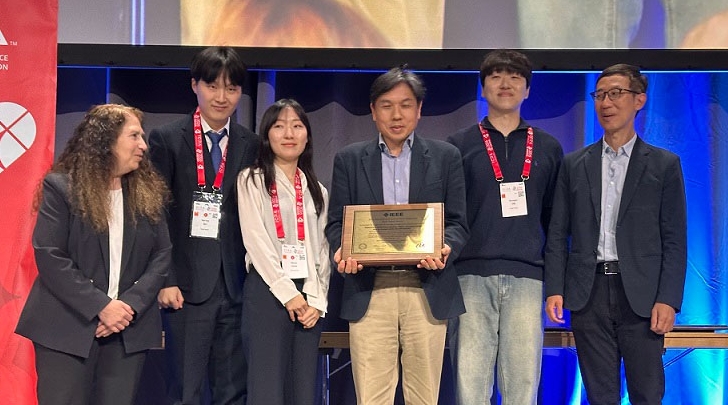

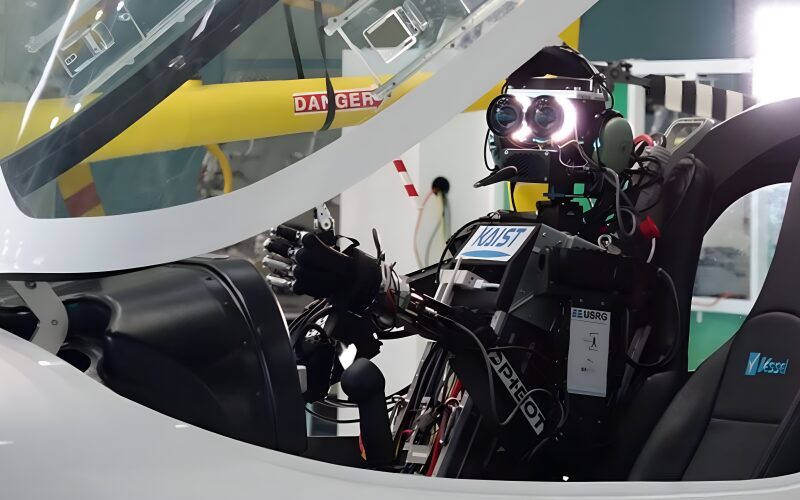
A paper proposing an aircraft autonomous piloting framework based on the humanoid robot pilot ‘PIBOT,’ developed by a research team led by Professor David Hyunchul Shim of the School of Electrical Engineering, was selected as the winner of the Best Paper Award among the papers published in the IEEE Robotics & Automation Magazine (IEEE RAM) in 2025.


The research team has successfully completed Phase 1 of the research since the project launched in 2021, and since 2024, they have been developing Phase 2 of the pilot robot, which features a human-like physique and joint structure suitable for actual aircraft piloting. In addition, they are pursuing collaborative research with relevant organizations to expand and apply this technology to various mobile vehicle piloting fields, such as ground vehicles and ships, as well as aircraft.

- Paper Title: “Toward Fully Autonomous Aviation: PIBOT, a Humanoid Robot Pilot for Human-Centric Aircraft Cockpits”,
- Paper Links: https://doi.org/10.1109/MRA.2024.3505774, https://ieeexplore.ieee.org/document/10798973/

The research project titled ‘Development of a Versatile/Secure/Intelligent Integrated Circuit (Future-IC) Platform for Future On-Device Physical AI System Innovation’ by Professor Minkyu Je’s lab has been selected for the 2026 Basic Research Program — Leader Research (Type A), organized by the Ministry of Science and ICT. The Leader Research program selects world-class researchers and provides intensive, long-term support over 9 years, representing one of Korea’s flagship basic research programs. Type A offers an annual research budget of approximately 800 million KRW.
With the arrival of the ‘Physical AI’ era — where AI expands into the physical world — new technological paradigms are being demanded in the field of on-device system semiconductors that power these systems. However, existing research has remained at the level of individually optimizing sensor interfaces, wireless communications, power management, and AI computing circuits, failing to overcome the fundamental barriers of fragmented market structures, security vulnerabilities, and scalability limitations.
To overcome these limitations, the research team aims to secure the world’s first original technology for VISIOn-IC (Versatile, Intelligent, and Secure On-Device IC), which integrates sensor/actuator interfaces, wireless communications, power management, and on-device AI computing circuits onto a single chip platform. Going beyond simple functional integration, the team pursues the realization of ‘AI-based autonomously operating system’ or ‘AI-defined system’ — in which an AI controller inside the chip independently recognizes and optimizes circuits — with Versatility, Security, and Autonomous Intelligence as its core values.
The VISIOn-IC platform technology developed through this research is expected not only to establish itself as a core enabling technology underpinning a wide range of Physical AI applications — including smart factories, healthcare, and wearables — but also make a significant contribution to the advancement of Korea’s system semiconductor industry.


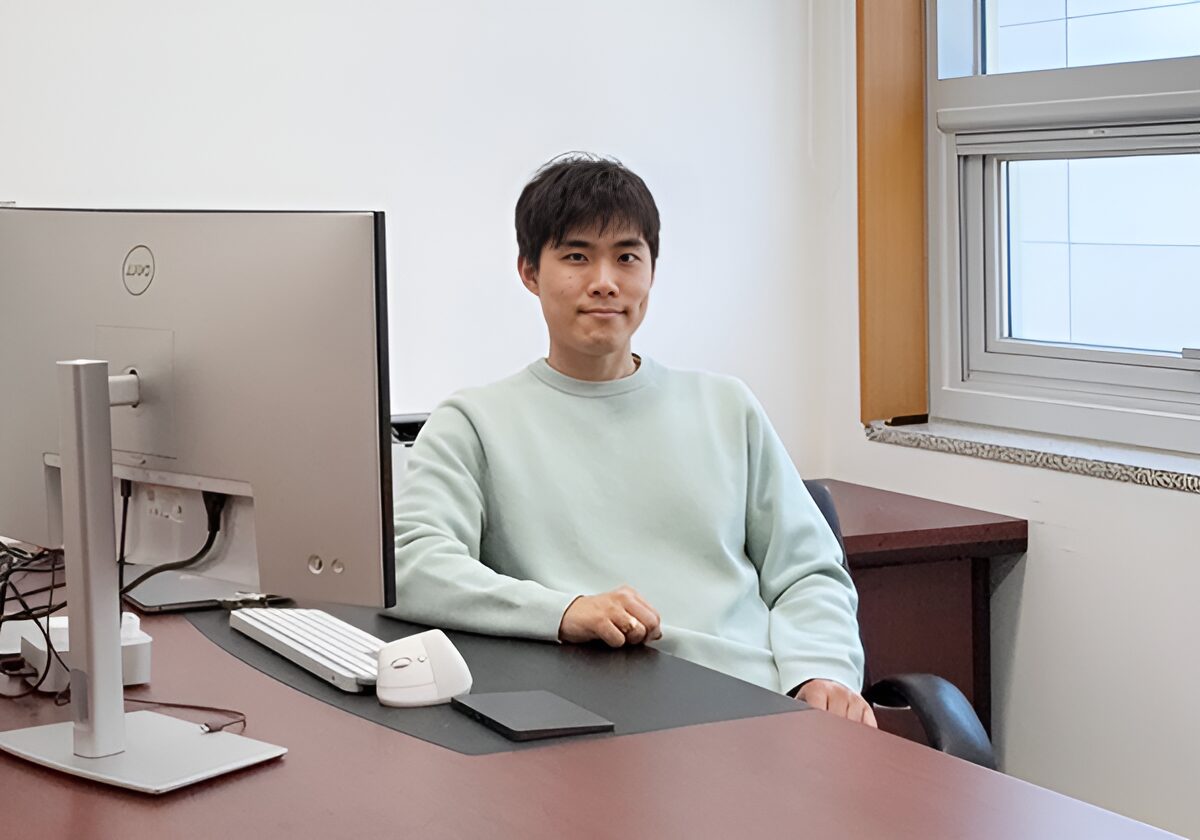
Clear imaging deep inside the living brain has traditionally required advanced optical systems and precise correction techniques. A research team from our department has developed a physics-based AI computational algorithm that can restore blurred biological microscopy images more clearly without additional wavefront measurement hardware.
Professor Iksung Kang (School of Electrical Engineering), in collaboration with Professor Na Ji’s research team at UC Berkeley, has developed a technology that accurately corrects image aberrations in microscopes used for live biological imaging. The experimental design and algorithm development – the core components of this work – were led by Professor Kang during his postdoctoral fellowship in Professor Na Ji’s group. This method uses neural fields, a neural network-based approach that represents 3D spatial structures continuously to reconstruct clearer images and volumetric information.
The research team utilized two-photon fluorescence microscopy, a key technique for observing deep inside living biological tissue. This method generates fluorescence when two photons are absorbed nearly simultaneously, enabling localized imaging within biological samples. However, as light passes through thick tissue, differences in refractive index distort the optical wavefront, causing the image to become blurred, much like how objects appear distorted underwater. This phenomenon is known as optical aberration, in which wavefront distortions degrade the focus and clarity of an image.
Previously, correcting these distortions required additional complex and costly hardware, such as wavefront sensors, which measure how much the optical wavefront is distorted.
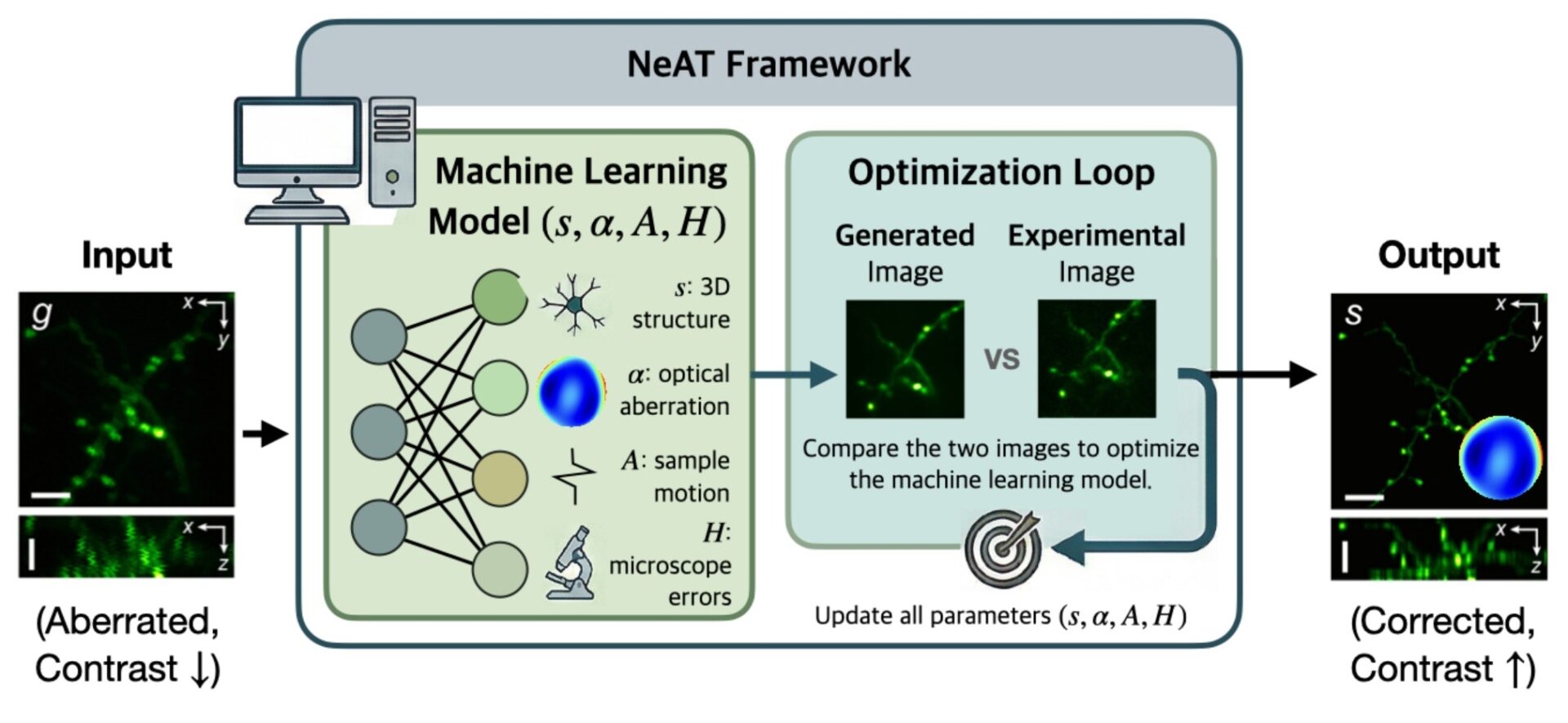
In contrast, the research team developed an algorithm that inversely calculates how light was distorted using only the acquired image data and corrects the distortion computationally. In other words, rather than simply sharpening a blurred image, the method incorporates the physical process of image formation to restore clearer images without additional wavefront measurement hardware.
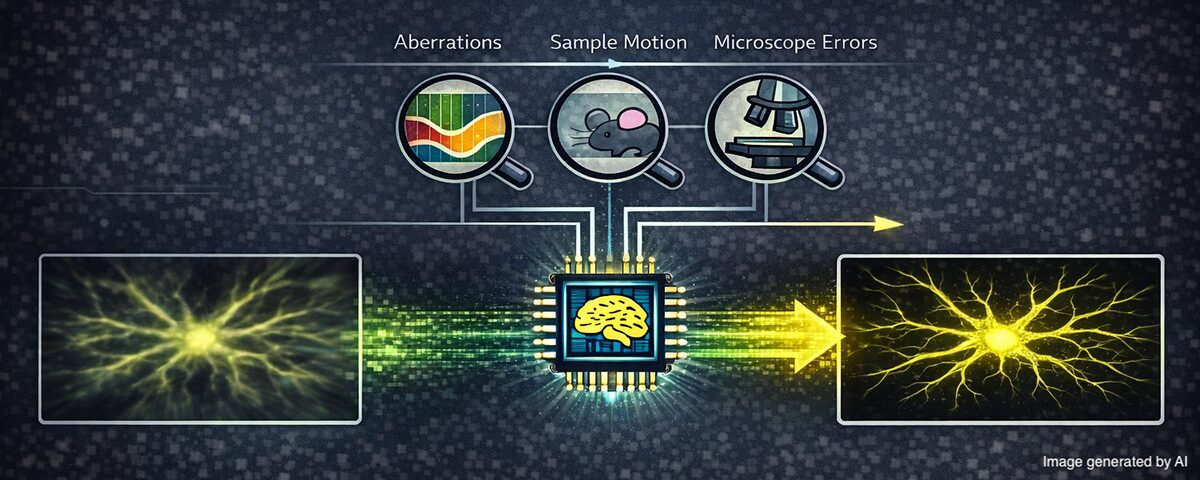
The core of this technology is a machine learning algorithm based on neural fields. This algorithm models the distortion process that occurs as light propagates through biological tissue and the microscope system, enabling an integrated framework that simultaneously corrects optical aberrations caused by biological tissue, subtle motion of the living specimen, and mechanical alignment errors in the microscope.
As a result, the team demonstrated that clearer, higher-contrast images can be obtained from deep biological tissues without separate optical wavefront measurement or correction devices.
This research is particularly significant because it moves beyond the conventional approach that better imaging often requires more complex and expensive hardware. Instead, it shows that software-based computational algorithms can improve microscopy image quality. This approach is expected to help reduce the burden of research equipment and experimental procedures, and to support more precise biological imaging for a broader range of researchers.
Professor Iksung Kang stated, “This research shows the potential of combining optics and artificial intelligence to more accurately observe the inside of living biological systems. Moving forward, we plan to develop this into an intelligent optical imaging system where the microscope can identify the optimal imaging conditions.”
This study was published on April 13th in Nature Methods, a leading methodology journal in the life sciences.
※ Paper Title: Adaptive optical correction for in vivo two-photon fluorescence microscopy with neural fields
※ Authors: Iksung Kang (KAIST, Co-corresponding & First Author), Hyeonggeon Kim, Ryan Natan, Qinrong Zhang, Stella X. Yu, & Na Ji (UC Berkeley, Co-corresponding Author)